Breaking the Mould: How Doing the Opposite Revitalized My Poetry

They say the definition of insanity is doing the same thing over and over and expecting different results. For a while, that was me. I had a comfortable poetry routine, and for a time it worked. But comfort has a way of dulling the edges. The poems began to sound alike. The spark that once lit up the page was starting to fade.

Routine, Until It Wasn’t

Most mornings I followed the same ritual: breakfast, then retreat to the small bedroom that doubled as my study. I’d put on music, quiet at first (usually Spotify) then louder with blues rock as I settled in, and draft a poem. The ideas came easily enough; poems are always floating past if you’re paying attention. Then I’d spend hours revising until I had something close to finished.

This routine held me for years. It was a cocoon, a safe place where poems steadily arrived. But after a while, I noticed I was recycling the same rhythms, the same gestures. I was producing, yes, but I wasn’t surprising myself anymore.

The Cruise That Shook Things Up

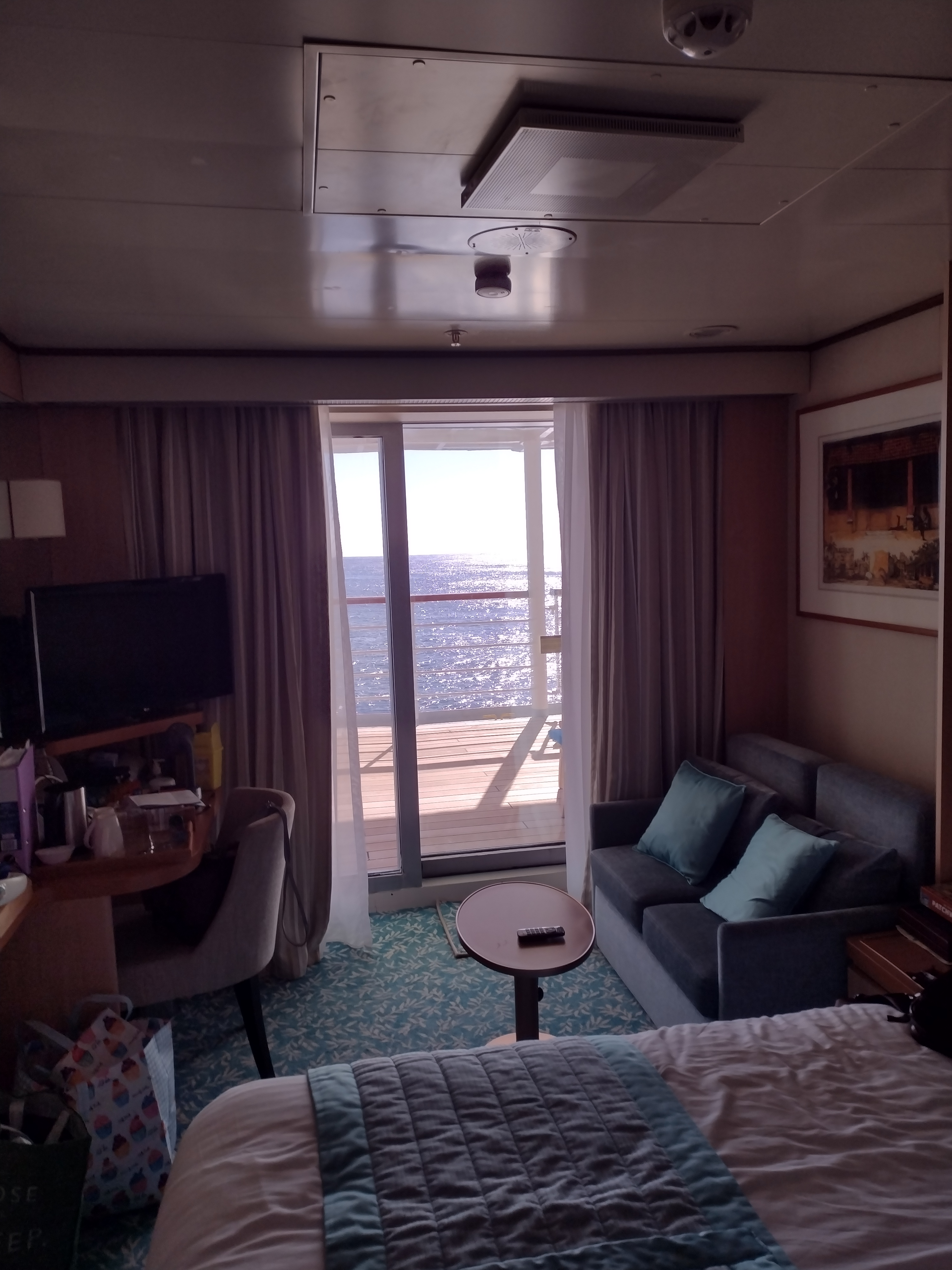
Then came the 100-day cruise. Suddenly my little cocoon was gone. No small bedroom, no desk, no predictable soundtrack. The ship itself became my writing room: a lounge chair by the bar upstairs or on the settee in the cabin writing on the tiny coffee table while the ocean rocked us forward.

Neal Pasricha writes, “Different is better than better.” On the ship I felt that in my bones. The artist Marina Abramović once quoted Krsto Hegedušić: “If you get so good at drawing with your right hand that you can even make a beautiful sketch with your eyes closed, you should immediately change to your left hand to avoid repeating yourself.”

That was exactly my situation. I was writing with the same hand over and over. The cruise forced me to change hands.

An Opposite Approach

Back home, I wanted to keep shaking things up. So I set myself a challenge: instead of labouring over one poem until it was polished, I would do the opposite. I would write 100 drafts, one after another, without pausing to perfect a single one.

At first it felt reckless, like running downhill too fast. I wasn’t allowed to hesitate, to weigh every word, or to polish a line until it gleamed. The rule was forward motion only. Some drafts fizzled slightly, others surprised me with sudden heat. But by the time I reached fifty, then seventy, then one hundred, I was exhilarated. I had built a momentum that my old routine never allowed.

When I finally circled back, I treated the drafts like old acquaintances. A quick hello, a light touch, then I moved on. Each round of revision deepened the work without killing the rawness that first sparked it. By the fifth or sixth pass, patterns began to emerge, echoes, connections, small threads that linked one poem to another. What I found wasn’t a single polished piece but a chorus of voices that gradually blended into something recognisably mine.

Drafting in bulk instead of fussing line by line gave me more than just a stack of poems. It gave me a stronger, more consistent style: a voice that wasn’t imposed, but discovered in the sheer act of repetition and return.

The Lessons of Opposites

I’ve tried this before. I wrote on crowded trains instead of in solitude. I wrote in the voices of objects, or my younger self, or even a plum tree. I started with the last line first. I scribbled in haiku when I was used to free verse. I used to do front of house work at an arts centre and wrote a poem the very next morning. Each experiment shook something loose.

Not every attempt worked. Some were disasters. But even those failures carried me somewhere new.

What I Learned

Doing the opposite wasn’t comfortable. My inner critic protested every step. But discomfort, I realized, was part of the point. It meant I was entering unfamiliar territory, where something unexpected could happen.

On that cruise, and in the months after, I learned this: if you want different results, you have to do something different. The poems I wrote taught me that surprise is the lifeblood of creativity, and routine, useful as it is, must sometimes be broken open.

So if your creativity ever feels stuck, try the opposite. Write in a noisy café instead of your quiet corner. Begin with the ending. Change your posture. Change your tools. Change your hand.

The opposite is waiting, and with it, something new.

Further Reading & Inspiration

If you’d like to follow up on some of the ideas in this post, here are a few books and voices that have shaped how I think about creativity in the past year:

  • Daily Rituals: How Artists Work by Mason Currey: short portraits of how different writers and artists structured (and disrupted) their days.
  • The Creative Habit by Twyla Tharp: a choreographer’s take on how habits can both nurture and limit creative work.
  • The Art of Noticing by Rob Walker: exercises for paying attention differently and seeing the world with fresh eyes.
  • Neil Pasricha’s The Happiness Equation (and his TED Talks): where the phrase “different is better than better” appears. His blogs are also worth checking out.
  • Marina Abramović’s writings and talks (especially Walk Through Walls: A Memoir): on challenging comfort zones as an artistic practice.
  • Bird by Bird by Anne Lamott: especially her advice on “shitty first drafts,” which resonates with my 100-draft experiment.
  • Art & Fear by David Bayles and Ted Orland: a slim classic on the anxieties and breakthroughs of making art.
  • Show Your Work! by Austin Kleon: emphasizes iteration, process, and openness.
  • Creative Doing: 75 Practical Exercises to Unblock Your Creative Potential in Your Work, Hobby, or Next Caree4 by Herbert Lui: does what it says on the tin really

Each of these, in its own way, reminds me that creativity thrives on surprise and that sometimes the best way forward is to do the opposite of what feels safe.

How I Wrote a Poem a Day on a World Cruise: When Reality Hits


When I set out on a world cruise last year, I had grand ideas about how I would write a poem every day. I’d prepared notes, ideas, and prompts — all neatly tucked away in a folder. But as soon as Day 1 arrived, that folder was forgotten and it seemed a stupid idea.. The reality of the journey reshaped everything. Here’s how I approached writing those daily poems without feeling overwhelmed:

One Day at a Time: The key was to treat it like I did when I gave up smoking twenty years ago when I was in New York — just stop smoking one day at a time, no stress. No hassle, it was something I could do, and it worked. So I never thought about writing 100 poems — just the poem for that day.

Establishing a Routine: It took a few days at sea to settle into a rhythm. My wife, Frances, and I spent most of our time together, but there was one hour each afternoon when she attended her singing class. That became my designated writing time.

A Quiet Space: I would follow Frances to the choir rehearsal, then find a quiet seat at the nearby bar (shut at that time of day) and write about the day before. I could turn my hearing aid off so it would be really quiet, although the bar was shut, a waiter would always come up to me and ask if I wanted a drink. This gave me a consistent place and time to reflect, get something down. My very first line was “the boat escapes under cover of darkness.”

Adapting to Port Days: When the ship was in port, there were no singing classes — and no regular writing time. Instead, I found a second routine: a short poem during the 20-minute bath before dinner, capturing the day’s experiences and realising I was not an explorer hunting for new adventures but a tourist. There’s the excitement of seeing new places, but also the sense of being an outsider, observing rather than belonging. Some experiences were fleeting, while others left a lasting impression. The poems became a way to engage more deeply with what I was seeing, not just ticking off sights but noticing the small details — the light, the people, the unexpected moments.

Poems vs. Journals: Writing poems rather than keeping a journal made the process feel more creative. A journal might have captured facts and events, but poems allowed me to distil each day into an essence — a mood, an image, or a small story. Poems offered a way to interpret the experience rather than just record it, leaving room for imagination as well as memory.

Momentum: By focusing only on the next poem, not the whole journey, I kept going without pressure. One poem led to another, until suddenly there were 100.

Adapting to Reality: What I’ve learned — and what others have often said — is that you can plan as much as you like, but reality often forces you to adapt. The trick is to go with it, find what works, and keep moving forward. As Winston Churchill said: “Plans are of little importance, but planning is essential.”

Mary Oliver, The Summer Day: A poem that encourages slowing down and noticing the world around you.

Rainer Maria Rilke, Letters to a Young Poet: Thoughts on creativity, solitude, and the importance of daily observation.

Elizabeth Bishop, Questions of Travel: Exploring the complexity of being a traveller, torn between wonder and detachment.

Embracing the Daily Poetry Challenge: A Guide to Preparation and Benefits

Setting the Stage for Success

1. Prepare Tools

– Dedicate a special notebook and pen for the poems

– Keep a small notepad or use a phone app for capturing ideas on-the-go

– Set up a comfortable writing space

2. Embrace the Process, Not Perfection

– Remember, the goal is consistency, not masterpieces

– Write “rubbish” poems – they’re stepping stones to improvement

– Experiment with different forms and techniques

The Power of Daily Poetic Practice

Writing a poem every day offers numerous benefits:

1. Continuous Growth: Each poem is a chance to learn and improve craft

2. Stress Reduction: The meditative nature of writing can lower stress levels

3. Increased Creativity: Regular practice encourages innovative thinking

4. Enhanced Self-awareness: Poetry helps explore my thoughts and feelings deeply

5. Improved Problem-solving: Creativity boosts the ability to tackle challenges uniquely

6. Building Resilience: Overcoming daily writing challenges strengthens perseverance

Drawing Inspiration from Daily Life

1. Sharpen Observation Skills

– Practice mindful awareness of surroundings

– Notice the small details in everyday scenes

– Pay attention to all senses

2. Mine Experiences

– Personal interactions

– Urban and natural environments

3. Capture Ideas Quickly

– Jot down interesting phrases or images

– Take quick notes or voice memos

– Sketch scenes or create mind maps

Integrating Poetry into Routine

1. Find Writing Time

– Choose a consistent daily slot (e.g., morning, lunch break, before bed)

– Start with just 5-10 minutes a day

2. Low-Pressure Approach

– Don’t aim for perfection – focus on showing up daily

– Allow yourself to explore and experiment freely

3. Stay Inspired

– Read poetry regularly

– Train the mind to think poetically throughout the day (whatever that means)

– Share the journey with a creative community

Some references:

A Poet’s Journey to Creative Discipline

Origins of the 100 Day Project

Michael Bierut created the 100 Day Project as an assignment for his graduate graphic design students at the Yale School of Art. The project was designed to encourage creativity, discipline, and consistent practice among his students[5]. Bierut assigned students to choose a design operation they could repeat every day for 100 days, roughly the length of a semester[9]. The only requirements were that the chosen operation had to be repeated daily and documented for eventual presentation.

Evolution and Themes

Since its inception, the project has evolved to include various themes and prompts:

– Personal Experience Themes

– Sensory and Descriptive Prompts

– Perspective-Based Prompts

– Emotional and Psychological Themes

– Creative Imagination Prompts

My Personal Journey

Initially, I thought, “This is silly, and I’ll never be able to keep it up.” Past attempts to write daily were often derailed by life events. However, the 100 Day Project presents an exciting opportunity to develop a consistent writing habit and produce a substantial body of work[1]. The recommended short daily time commitment seems manageable, even while at sea for 60% of the time without internet access.

How to Participate

1. Join the project and sign up for a newsletter at https://www.the100dayproject.org/

2. Set a clear goal for your poetry (in my case, writing a book)

3. Commit to writing a poem daily (10-15 minutes recommended)

Tips for Success

– Start small and be realistic about your goals[1]

– Prepare in advance by setting up a dedicated space and informing those around you[1]

– Use excitement to get started, but rely on discipline to finish[4]

– Make the writing process as easy as possible to maintain consistency[4]

By following these suggestions, you can create a more engaging and informative blog post about your 100 Day Poetry Challenge journey.

If you want to read up further blog references on poets who had done the 100 day challenge then here are some references

https://booksnob-booksnob.blogspot.com/2021/04/day-27-of-100-day-poetry-project.html

https://www.100daysscotland.co.uk/lindsay-oliver-2021

The 100 Poems In A Day Project

https://www.pinterest.com/pin/pinterest–242561129900224788

https://craftindustryalliance.org/tips-and-tools-for-creating-a-successful-100-day-project/

https://www.writingforward.com/writing-prompts/poetry-prompts/100-poetry-prompts

https://www.freelancewriting.com/feature-articles/100-days-of-poetry/