Landfall: Finishing Postcards from the Floating World

After months of writing, editing, and second-guessing, I’ve arrived at that strange, quiet point where the poems from Postcards from the Floating World feel finished — or at least as finished as they’re going to get. Any new revision just creates another version of the same poem, not a better one. It’s a familiar kind of exhaustion and satisfaction, like getting home after a long voyage. You unpack your bags, look at the souvenirs, and realise that while you’ve come a long way, part of you is still swaying with the sea.

This project began on a world cruise. One hundred and two nights, one short poem a day. It started as a private challenge — a way to record what I saw, said, overheard, and imagined while the ship moved across time zones and weather systems.

Some days I wrote beside the pool while crew members hosed down the deck. Other days I sat in the bar listening to the choir practice. A few times I even scribbled lines in the cabin coffee table while Frances had a bath.

Soon the poems became their own kind of travelogue. Some were small sketches of a moment, others more like letters to myself, written from the middle of nowhere. Together, they started to form a record of motion and stillness — of people temporarily unanchored, and the odd beauty of routine life at sea. And there were a lot of days at sea, about 66.

There are love poems, weather reports, being scared, elegies, jokes — in fact a whole floating city’s worth of human voices.

Coming home, I started revising. And revising. And revising again. At first it was thrilling — I could see the weak spots and fix them. Then the process slowed. I’d move a comma, break a line differently, shift a word, then shift it back. Eventually I realised I wasn’t improving the poems anymore, just orbiting them. Each change made a slightly different version of the same thought, and none felt more “right” than the others. That’s when I knew I’d reached the end of the creative phase.

Of course, it’s difficult enough to know when a single poem is finished, let alone a whole collection. A poem can stop moving, but that doesn’t mean it’s complete. With a collection, there’s the extra question of consistency — not just in tone, but in voice. Does the same speaker inhabit all these pages, or are there several versions of me talking at once? I’ve tried to keep the voice steady, honest, and recognisably mine, even as the settings and moods shift from port to port.

That’s not to say the poems are perfect — I don’t believe in perfect poems. But they’re good enough, and as honest as I can make them. About a quarter have already been published in magazines, which gives me a quiet sense of validation that they hold up in the wider world. The rest are waiting their turn, patient and self-contained, ready to be gathered together.

What surprised me most was how the poems began to speak to one another. A line written in the Pacific suddenly echoed something from the Atlantic weeks earlier. It was as if the poems knew more about the journey than I did. And then of course there was hearing about my brother being taken into hospital, and later still dying.

I’ve learned that perfection isn’t the goal; connection is. If a poem can make someone pause, smile, or remember something they’d forgotten, then it’s done its work. These poems carry what I wanted to say in the voice that emerged while I was writing them, and I trust that voice now more than I ever did at the start.

So, what happens next? The obvious next step is a book. The sequence already has a shape: a beginning full of movement and discovery, a middle of reflection and routine, and an ending that tilts toward home and stillness.

It’s called Postcards from the Floating World, which feels right — each poem a snapshot from a drifting moment. I imagine the book like a box of postcards you find in a drawer years later, each one holding a piece of a life that was temporarily unmoored.

Before publication, there are the practical choices: layout, order, notes, the question of whether to include photographs or keep it purely textual. But these decisions feel lighter than the creative work. They’re about presentation, not invention. The hard part — finding the voice, building the rhythm, discovering what the poems wanted to be — is done.

Writing every day taught me that inspiration is overrated — most days, you just show up and trust that something small will open. The sea doesn’t perform for you; it just keeps moving. I still catch myself noticing things in the same way — a snatch of conversation, a shaft of light, a stranger’s awkward grace. Maybe those will feed into something new. But for now, I’m content to stand on the deck and watch this one come to shore.

If you’ve followed bits of this journey, thank you. These poems began as private notes and have turned into something I can share. Postcards from the Floating World will become a book soon — something to hold in your hands rather than scroll past. I’ll share more once the tide carries it into print.

Finishing a project like this doesn’t feel like triumph. It feels like gratitude — for the words that arrived, the days that held them, and the ship that kept moving forward even when I wasn’t sure where we were going.


About the author:
Rodney Wood lives in Farnborough and writes poems about travel, memory, and the odd grace of everyday life. Postcards from the Floating World grew from a world cruise, where he wrote one poem each night for 102 nights. A quarter of the poems have already appeared in magazines including The High Window, Seventh Quarry, Black Nore and Morphrog. The full collection is now sailing toward book form.

If you enjoyed this post, feel free to subscribe, leave a comment, or share a memory of your own journey — on land or at sea.

What the Cruise Poems Say About Me

After living with these poems for more than a year, I’ve started to see the person inside them more clearly — not the real me exactly, but the outline of someone I once allowed to speak.

That person has good qualities.
They pay attention. They know how to listen for the small sounds: the hiss of disinfectant, the tremor of glassware, the shuffle of passengers settling into seats. They look carefully, maybe too carefully, and turn each detail into a kind of evidence. There’s tenderness in that, and humour too — a quiet irony that keeps sentiment from tipping over.

They also understand the strange ethics of travel. How beauty and guilt can sit side by side at a buffet table. How privilege can shimmer like sea light, easy to admire, hard to ignore. I like that about them — their moral curiosity, their unwillingness to look away.

But there are flaws too.
This poet, this traveller, sometimes hides behind the act of noticing. They stay a little too safe, too composed, always the watcher and rarely the one watched. The voice can become too even, too polite, like a dinner conversation that never quite gets personal.

And sometimes they list the world instead of living in it.
The poems start collecting things — sunsets, cocktails, towels — until the rhythm turns static, as if observation alone could replace experience.

Still, I don’t dislike this version of myself. They were trying to be honest, and to be kind. Maybe they were learning how to see.

If the next poems are different — more sprawling, less well-behaved, full of weather and interruption — it’s because I’ve stepped back into the middle of life. The watcher is still there somewhere, scanning the horizon, but the poems will have to make room now for the person who keeps missing the boat.

Postcards From the Floating World: Letting the Poems Go

For a long time, these poems lived in notebooks and drafts, jotted down each day aboard a ship circling the world. They began as small postcards to myself—10-line dispatches from the deck, from memory, from wherever the sea carried us. Over the past year, I’ve revisited each one, sometimes gently, sometimes with a scalpel, trying to listen for the real voice underneath. My voice.

Some poems didn’t make the final cut into the collection. A few felt too similar in tone or subject to others, some didn’t quite carry the same voice as the rest of the collection, and a handful, let’s be honest, were probably beyond redemption. But I’m not concerned. They could be replaced easily enough by my stories of previous cruises of events I would have talked over with our little group of friends we chatted to every night.

I’ve edited every poem now. Not just for line breaks or punctuation, but to be sure each one sounds like me. That they belong to the same world. That they carry the tone I meant, even when I wasn’t sure what I meant at the time.

DAY 83: EPITAPH FOR A DAGGA BOY (CAPE TOWN)

    Mark, our guide, eases the jeep to a gentle halt,
    and we fall quiet where old bones sprawl,
    brittle edges breathing dust and dried blood,
    sun-baked marrow, silence thick as heat.

    A buffalo’s ghost still lingers here:
    its hooves once thundered the open plain,
    its breath defied the wind’s sharp reply.
    In its prime, a match for anything wild.

    Vultures pirouette the sky above
    in a slow, macabre ballet of wings.
    Ragged feathers rasp against dry air,
    like sandpaper drawn across a drum.

    Their shadows reel across cracked, red earth.
    Hyenas skulk just beyond the scrub,
    their laughter splits the afternoon wide open
    like a snapped femur, white and unclean.

    Mark surveys the scene, his brow furrowed tight.
    “Looks like this old Dagga Boy,” he says,
    “couldn’t keep up.” His voice dips, softening
    the way it does with what can’t be explained.

    “He picked a good spot by the river’s bend,
    golden grass, mud baths, the works,” he says.
    “A buffalo’s kind of retirement.
    No golf carts though, ja?” His smile flickers,
    fading as he stares down at the bones again.

    “Had a decent run, I’d reckon,” he adds,
    leaning back with a slow and satisfied creak.
    “Stood his ground, maybe found love out here
    beneath the thorn trees, in the dry season.”

    The jeep roars again, kicking up old dust.
    We lurch forward, heat waves curling ahead,
    leaving the skull grinning in our wake
    as if it knows something we’d rather not.
    Another mile, another hour slips by,
    closer to whatever waits in the grass.

    The next step is to begin letting them go.

    I’ll be sending them out in small batches, one a week, to magazines that might welcome them. I don’t expect a flood of acceptances, but I do believe these poems will find their way. Here’s a list I’m considering but of course there are many other magazines I want to submit to, and of course there are poetry competitions as well.

    Here’s a list of some journals I’m considering:

    • Atrium – Emotionally resonant, well-crafted poems that balance clarity with depth.
    • Bad Lilies – Bold, contemporary, often formally adventurous work.
    • Interpreter’s House – Thoughtful, image-rich poems with a narrative thread.
    • London Grip – Accessible, reflective poems, often subtly political.
    • Magma – Regularly welcomes travel-based or themed submissions.
    • New Ohio Review – Image-rich, humane poetry with emotional resonance.
    • Ploughshares – Prestigious but approachable for grounded, serious work.
    • Poetry Review – Ambitious, layered poems with strong, distinctive voices.
    • Rattle – Open to narrative, humorous, and heartfelt poems.
    • The Fig Tree – Visual, nature-inflected or spiritual poems.
    • The High Window – Lyrical poetry with an international or literary edge.
    • The Long Poem Magazine – Poems over 50 lines: narrative, meditative, or experimental.
    • The North – Intelligent, place-based, and reflective poems.
    • The Rialto – Original work with character and clarity.
    • The Seventh Quarry – Musical poems with international flavour.
    • The Southern Review – Place-rooted, quietly observant poems.
    • The Threepenny Review – Clear imagery, wit, and understatement.
    • Under the Radar – Emotional, precise, and accessible poetry.
    • Wild Court – Welcomes both lyrical and narrative work.

    I believe they should be published because they speak to experiences many people share but don’t always talk about: the strangeness of time at sea, the joy of small rituals, the weight and humour of memory, and the quiet ways we carry grief and love. They’re not grand or showy, but they’re honest. And sometimes, honesty travels furthest.

    Publishing in magazines isn’t just about recognition, it’s about giving them a place in the world beyond my notebook. Letting them speak to someone else, as they once spoke to me.

    After so long living with them, the thought of sharing them feels both unsettling and necessary, like watching something you’ve grown used to keeping close begin to take its own shape and life elsewhere.

    If you’re reading this and know of magazines or journals that might be a good fit, feel free to suggest them as I’m open to surprises.

    Thanks for following the journey so far. I’ll post updates as the poems begin to appear, if and when they do.

    Before You Hit ‘Send’: A Poetry Completion Checklist


    After writing and revising over a hundred poems for my cruise collection, I realised I often forgot the same basic things—especially when I was close to finishing a poem. So I made this checklist to help me decide when a poem is done. Or at least ready to be read aloud or sent out.


    Poetry Completion Checklist

    At each revision stage, here are some of the questions I sometimes forget to ask myself—but should:

    Does the poem have a single, clear central idea or theme?
    Are sensory details present to help readers see, hear, and feel the poem’s world?
    Is the point of view consistent? (Shifting POV can confuse, unless it’s intentional and clearly handled.)
    Are the tenses consistent throughout?
    Does the poem evoke the emotion I intended?
    Is the structure logical and coherent?
    Have I checked spelling and grammar carefully?
    Are homophones and typos corrected?
    Are the images and metaphors clear, vivid, and effective?
    Am I showing rather than telling? (Does the poem evoke emotion through language and imagery?)
    Does it still feel authentic and true to my voice?
    Will the poem connect with a reader’s emotions, memories, or curiosity?
    Does the poem still surprise me?
    Is there a reason for the reader to care?
    Is the rhythm consistent, and does the poem flow easily?
    Is there any awkward phrasing?
    Are there any unnecessary words or lines that don’t add anything?
    Have I read it aloud to catch any clunky bits or flat patches? (Reading often reveals things I don’t see on the page.)
    Is everything clear enough for a reader who isn’t me? (What’s obvious to me might not be to someone else.)
    Am I revising to improve the poem or just out of habit or fear of letting it go?

    That’s already a long list and there are always more questions. But after I’ve been through this process (sometimes too many times), and I think the poem might be finished, I still ask myself a few final things:

    The Afterthought Stage

    1) Would I be happy to perform this poem to an audience, at a reading or an open mic, or send it out to magazines?
    There’s nothing worse than reading a poem you thought was brilliant and realising halfway through that it’s not working.

    2) Have I revised this poem so many times that I’m now just producing another version of the same thing?
    Not better, just different. Like Monet’s 25 versions of Haystacks—sometimes the changes are variations, not improvements. I’m no longer making real progress, just rearranging the same ideas.
    me spot what’s missing or give me permission to stop editing and let the poem go.

    Every poet needs their own process and I’ve found that having a checklist like this helps me avoid finishing too soon or revising forever. In the end, it’s about finding the balance between control and letting go. And trusting that, even if this version isn’t perfect, it’s the one ready to meet the world. My cruise poems are now ready.

    When the Poem Fought Back: On Revision, Rejection and Cricket

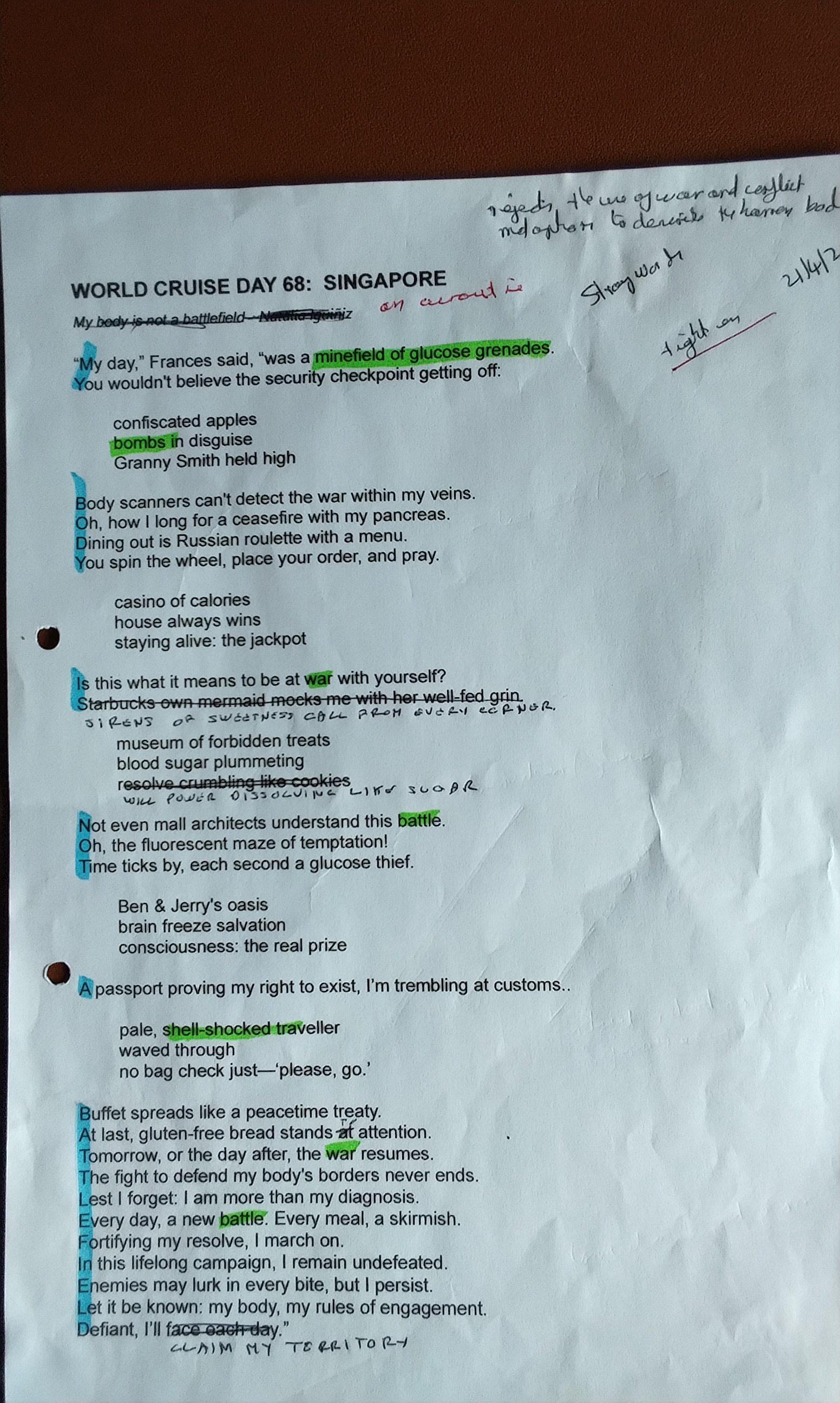
    Some poems fight you every step of the way. This one did—from its first draft to its final line. It began with toast Frances couldn’t eat.

    Not the sandwich at lunch, not the biscuits with her tea. Coeliac disease had turned her world into a minefield of gluten, and that day in Singapore, everything seemed to contain the very thing that would leave her in pain and in danger of slipping into a coma.

    I started with a free verse draft, voice-led, trying to channel Frances’s experience directly. Her words, her frustration, her body’s rebellion against what should have been simple nourishment. It felt right to let the poem breathe in short lines, unforced, raw.

    I was pleased enough with it to submit. A few weeks later, it was accepted. Except, no contributor copy, no proof. Just an email telling me to buy the magazine if I wanted to see it in print. I’d found the callout on Facebook and hadn’t checked the fine print. My fault entirely. But it stung. I never bought the magazine, never saw my name on the contents page. Does that count as being published? I’m still not sure.

    Still, the poem nagged at me. Frances lives with real discomfort, daily limitations. If I was going to write about her experience, shouldn’t the writing cost me something? Shouldn’t I feel some of the tightrope she walks?

    I remembered one of her refrains: “My body is not a battlefield.” She hated the military metaphors people lazily applied to illness. I took those six words and built an acrostic around them, weaving five haikus between each one.

    It took weeks. I sweated over every syllable, every line break. The constraint forced me to slow down, to pay attention. I thought I’d finally created something that honoured her pain and the challenge of translating it into language.

    I thought it was brilliant. Others agreed with me. Frances didn’t.

    “It doesn’t quite work,” she said. And when I looked again, especially alongside other poems in my collection, I had to admit she was right. It felt strained: clever, maybe, but ultimately artificial. Like I was trying too hard to be poetic about someone else’s pain. Writing it was like breaking a leg; you don’t want to do it again.

    So I rewrote it. In my own voice, with my own metaphor.

    I played school cricket once, when I was fourteen. Scored 48 runs, half our total that day. I walked back proud, expecting a nod from the coach. Instead, he tore into me in front of the team: “Stop slogging the ball!” Despite contributing most of our score, I’d failed, apparently, to play the right way.

    That stayed with me. I played safe for a long while after that.

    So I wrote into that memory. Into the feeling of doing your best, getting it wrong, being misunderstood. Into the helplessness of watching someone you love suffer and not always knowing how to help. That was my way in. I couldn’t write her pain. But I could write about my place beside it.

    The cricket metaphor worked because it was mine. It carried the sting of remembered embarrassment, the complexity of good intentions gone awry. It gave me a way to be honest without overreaching.

    Sometimes, the best way to honour someone else’s story is to find the place where it intersects with your own. Even if that place is a cricket pavilion, twenty-five years ago, where a boy learned that effort doesn’t always equal approval.

    The poem still isn’t perfect. But it’s true in a way the others weren’t.

    DAY 68: TRAVEL IS LIKE CRICKET WITHOUT A BOX (SINGAPORE)

    Frances is coeliac and diabetic. Travel, for her,
    is like cricket: the rules are incomprehensible,
    the danger accumulates slowly, and eventually,
    something hits you in the gut.

    No food allowed ashore. An apple becomes
    a threat to National Security.
    We should’ve stopped at M&S, filled a bag with snacks
    and called them “religious relics.”
    Frances shrugs. “Typical. Obey the rules, go hungry.”

    We walk the bay, pass sushi bars, bubble tea kiosks,
    Hello Kitty blinking from neon signs.
    Frances says, “Beautiful city, but everything wants to kill me.”

    At Marina Bay Sands, cinnamon spirals
    from a doughnut cart, naan sizzles
    behind glass. She sits on a low wall,
    hands trembling like leaves.
    I pass her a fruit pastille. She chews without speaking,
    like someone trying to stay conscious through a sermon.

    Frances squeezes my hand, once, hard—
    for comfort, and to stay upright.
    Starbucks has nothing safe.
    Just posters smug with gluten.
    She sits beside a polished escalator,
    face pale, breath shallow.

    I’m rehearsing collapse, seeing her fall before she does,
    imagining the sound her skull would make on tile.
    We ride the subway to another mall—
    air-conditioned, endless, engineered to trap the weak.

    At passport control, the guard waves us through
    with a look that says just go.
    Her look says what I won’t:
    this is an emergency.

    Back on board, the buffet glows
    like salvation. She eats slowly.
    Colour returns to her cheeks like dawn.

    “I feel human again,” she says.

    I say nothing, but I think:
    God, I love her. Even if sometimes I feel
    I’m facing Fred Trueman and I’m not wearing a box.


    Finishing What I Started: From 10-Line Drafts to Finished Poems

    Sometimes you just need to finish things.

    During a 100-day project on a world cruise, I wrote a 10-line poem each day — small daily acts of observation, memory, weather, and whim. I used two notebooks: one to scribble down each poem, the other to transcribe the same poem in my best handwriting, as a kind of ritual, or record.

    I recently opened the second book and realised, to my dismay, it stopped at Day 57. For some reason, I’d never caught up. So I did what needed doing. Using Speechnotes, a speech-to-text app, I dictated the missing poems from the original notebook and pasted them in. Where that didn’t work, I simply cut out the handwritten pages and glued them down. Now, finally, I have a complete physical record of the process: 102 days’ worth of daily poems. One phase finished. And I could move on.

    Returning Home: The Shift Toward Revision

    Reading back over the poems surprised me. A few had a shape, an insight, a flicker of unexpected imagery. It turned out that doing something every day, even quickly, had taught me something. So I decided to revise all the poems — in order — from Day 1 to Day 100. I hoped this would give the whole collection a more consistent voice.

    I didn’t revise once. I went through them again. And again. And again — until each poem felt finished, or at least alive in its own right. This process took about 15 months.

    Some poems were sent out during the process and published (in slightly earlier forms) in Wildfire Words, The Lake, Morphrog, Fig Tree, Stray Words, The High Window, Poetry & All That Jazz, The Pomegranate (London), Seventh Quarry, and Black Nore Review. These small acceptances gave me encouragement — but also made me keep working, keep returning, keep refining.

    What I Learned in the Process

    The revision work was repetitive but revealing. I kept catching myself doing the same things wrong:

    Starting too early, and ending far too late.

    Leaving in lines that were clever but unnecessary.

    Getting overly emotional without clarity.

    Forgetting to say what I really wanted to say.

    And quite often, not sounding quite like myself.

    Some drafts were just awful — others were rewrites of earlier pieces. Still, the process of revision was where the real poems emerged. “First thought best thought” is a myth. As Ernest Hemingway said: “The only kind of writing is rewriting.”

    What Comes Next
    Now I have 100 finished poems. Not just daily jottings, but poems that feel like they belong together — as part of a single body of work. The next step is shaping these into a book. I’ve been thinking about structure, tone, voice, and how the poems echo each other. There’s still work to do, but it finally feels like a book is taking shape.

    And all because I went back to finish something I’d started.