Last week I received four rejections in the space of a few days. Close enough together to feel cumulative. I reminded myself, as I always do, that there are many reasons a strong poem is turned away.
Not a fit for the journal A poem can be doing serious work and still fall outside a journal’s aesthetic or tonal frame. Editors shape issues deliberately. Fit is curatorial, not evaluative. Rejection here says nothing about the poem’s durability.
The editor already has enough poems Space is finite. Once a balance of voices, forms, or subjects is reached, later submissions face a higher bar regardless of quality. Timing often outweighs merit. Many strong poems arrive after the door has effectively closed.
The poem was read after several stronger or similar pieces Reading is comparative, not absolute. When poems echo themes or structures already encountered, even a good one can feel diminished. Fatigue is contextual. In a different sequence, the poem may have stood out.
The editor read it on a crowded, distracted day Submissions are often read between other obligations. Attention is uneven. Energy is limited. Subtle work can be missed under these conditions. The poem did not fail the reader. The reading failed the poem.
Rejected for logistical reasons, not merit Editorial calendars, themed issues, internal debates, and shifting priorities all shape decisions. Many rejections come after a poem has been taken seriously. Silence or form replies often mask constraint rather than judgment.
Of course I feel disappointed. Rejection costs something. But I do not feel judged. A rejection is not a verdict on the poem’s intelligence, ambition, or future. It is a situational decision made under conditions I cannot see.
My responses vary. Sometimes the poem goes straight to the next journal unchanged, a belief that the work is finished and the context was wrong. Sometimes I let it sit, then return with cooler attention. Distance can expose slack, or confirm the poem’s integrity.
I try not to revise aggressively to preempt rejection. Risk and strangeness are easy to trim and hard to restore. More often, I shelve the poem and write something new, accepting that not every strong poem needs an outlet immediately. Over time, rejection becomes background noise.
There is no ideal response. What matters is whether the response allows the work to continue. I like Sylvia Plath’s response “I love my rejection slips. They show me I try.” Tony Hoagland reminds me that editors are often protecting a framework, not judging a life’s work. Mary Oliver frames rejection as ordinary labour, endures.
1. Opening scene A decade ago, a poet handing out a stapled pamphlet at an open mic in Leeds or Hackney risked being quietly dismissed. If your work did not pass through a recognised press, people assumed you had missed the mark. The rule was never written down, but everyone knew it. You had to be serious.
2. What “proper poet” used to mean Serious poets subscribed to Poetry Review, PN Review and The Rialto. They clocked every new issue of magazines such as Magma, Ambit, Butcher’s Dog and Acumen. They tracked pamphlet releases from Smith Doorstop, HappenStance, Shoestring and Tall-lighthouse. They knew who had moved from Faber to Picador or stepped across to Cape. They knew about the canon, even championed obscure ones. This was the culture of correctness and it was a full-time job. Oh yes, they were mostly men.
3. Why things changed Digital tools lowered barriers. Print on demand services such as KDP, IngramSpark and Lulu brought costs down. Mixam and Ex Why Zed made small runs viable. A poet in Norwich could design a cover, send the file to print and have twenty books ready for a weekend fair. The poet did not need a gatekeeper to check it was good enough, would sell enough copies, eventually say yes. Or no
4. The poet changed too The rise of spoken word reshaped expectations. Poets were no longer only page writers queuing for magazine slots. They were performers touring pubs, bars and festivals. Open mics across London, Manchester, Bristol, Liverpool, Cardiff and here in Woking created active scenes for local people to become involved in. A poem refined on stage fed straight into a hand sold pamphlet. The poet became author, editor, promoter, bookseller and sometimes publisher.
5. The new audience Spoken word brought people who had never read Poetry Review into the room. They bought what moved them. Salena Godden, Joelle Taylor, Robert Garnham built loyal followings through live work long before anyone took notice. When those readers wanted the poems in print, self published or micro press books filled the gap.
6. The new landscape Tables at Ledbury, the London Small Press Fair show self published work stacked beside titles from Nine Arches, Verve, Bad Betty, Fly On The Wall, Paper Swans and Bloodaxe. But publishing is a precarious trade. Small presses stretch shoestring budgets, depend on grant cycles and volunteer labour, and sometimes fold without warning. In the past decade presses such as Tall Lighthouse and Eyewear have closed or paused activity. Others shrink their lists or skip a season when money or time runs short. A poet who waited years for a perfect home could watch it disappear overnight. Self publishing became a practical safeguard against this uncertainty.
7. Money and control A ten pound pamphlet printed through Mixam might cost two pounds per copy. Sell it after a reading and the poet keeps most of the margin. In a traditional deal the poet might receive one or two pounds per copy. Self publishing also means choosing artwork, correcting drafts immediately and reprinting on your own schedule.
8. Where the old stigma still clings Some gates remain narrow. Prizes such as the Forward and T S Eliot typically accept books submitted by publishers. National review pages lean toward Picador, Faber, Cape and Carcanet catalogues. Yet blogs and podcasts including The Poetry School, Sabotage Reviews and Lunar Poetry regularly feature self published titles.
9. Choosing what fits your life A press such as Carcanet, Bloodaxe or Peepal Tree works well for poets who want editorial depth and distribution. For occasional writers or anyone who cannot spare hours each day sending to magazines, a local print shop may be the simplest route. Design a cover, order fifty copies, give or sell them to friends and local readers. Either way the work reaches the world.
10. Closing reflection The definition of a poet has widened. No longer confined to pages in sanctioned magazines, poets now read, perform, film, post and print on their own terms. Some still pursue the traditional ladder. Others build their own steps. A poem that connects with a listener or reader counts. The route it travelled is no longer the test. So this year I will self-publish a book.
Barry Smith invited me to read here yesterday. Arrived at 7 at the Vic Institute to be met by the MC Mike Carey, a dab hand at the piano as well. I was on first and read a set dealing with thin hair, Genesis, death and love (of course, after all it’s our 50th anniversary at the end of the month) to an audience who were not that used to poetry, but I made them laugh in a few places, and there was a decent applause at the end. In the second half, Maria Jastrezebska read some poems from her book “Small Odysseys” which are still rattling my head at the moment. I was also treated to some songs by Amanda Waring ( Noel Coward and music Hall) and she also took part in a double hander with Bill Brennan. a spoof of Brief Encounter, and the Theatre Designer who explained how he makes 3D designs rather than draws then so he can see the actors in space.
I’m reading this a few days after her funeral. The service was all in Italian but there was an English translation which made it easier to follow. On Saturday 11 March Greg Freeman phoned me to say that Carla had suddenly died. Five minutes later I left the house to attend the poetry prizegiving at the Farnham Literary Festival. There was an open mic after the awards and I wanted to read a poem for Carla. This was the only poem I had on me and it seemed right somehow reminding us to be alive and reminding us that Carla was also alive. I also read the poem at Winchester Muse where David Cooke, editor of The High Window, wanted to use it in the magazine, where it appeared a few days later, because Carla had written reviews there, was published under their imprint and was their Artist in Residence.
The wonderful and engimatic poet, Rodney Wood is joining us today.
Applause – Crowd go mad – security is called (again)
Rodney elegantly descends the lighted stairs
Now, settle down, Poetry Lovers! Let’s let our guest take his seat
Cool hat, Rodney! I think this is the hat – is it not? It certainly has a story to tell!
Every hat tells a story, Heather. I particularly like this one as it goes with my tie dye vest
Oh Rodney, you are so cool ! Tie dye is the way to go! How long did you stand at that sink to get such a strong shade of pink? Isn’t he the most, everybody?!
pandemonium
Now calm down, Poetry Lovers, because I’m chomping at the bit to ask Rodney his first question – How did poetry become a part of your life?
In my very late 20’s, I spent a week with the poet lorryeate of Milton Keynes, Bill Billing, at Open University Summer School. He introduced me to poetry (and much else) and encouraged me to “just write”.
I was able to thank him a few years later by putting him on the stage with his hero, Ivor Cutler, in Aldershot and by buying him some SAS wings. From that stage I continued to write bad poems.
Fabulous, Rodney! How I’d love to interview those guys too! You’ve certainly come a long way, and so modest!
Now which poets influenced you the most?
Elizabeth Bishop, Raymond Carver, Ken Smith and Matthew Sweeney. I fell in love with them and read everything they’d ever written. When I had the chance to meet Ken and Matthew (who was writer in residence at nearby Farnham. He invited me to a reading once but didn’t tell me the audience would be made up of sixth form schoolgirls) they were both so kind and generous that I just wanted to become part of that world.
I had much to learn so paid weekly visits to the Poetry Library, went on Arvon courses, was one of the founder members of the OU Poets and put on about a dozen poetry readings.
Rodney! That is so impressive! An inspiring example of what we do for our passion and art.
spontaneous applause
And what a CV! Tell us about your pamphlet Dante called you Beatrice, published by Red Ceiling Press. How did you come to write it?
I’d read so many books with dedications to a significant other and I thought well why not write all the love poems to and for that person. Found the title by the way from a book by Paul Potts, not the opera singing one.
Geoffrey Pimlott told me how he’d been a landscape watercolourist but when he saw how computers could generate the same result, he had to do something different. I invented a new form that was short, based on repetition and mucked around with the structure.
The last thing to fall in place was the cover. I’d seen the Cuban artist’s work while I was on holiday and emailed him (Raul Cordero) to say how much I enjoyed his exhibition. A few years later, I emailed him again and asked if I could use one specific painting. He replied that I could use any one of his paintings I wanted. That generosity again.
Todd Swift, of Eyewear Publishing, called it a lovely little book and gave me much needed confidence. “When did you start getting good” he said.
Love it, Rodney! What a story! And that was praise indeed!
Now, can you elaborate on starting Write Out Loud Woking with the wonderful Greg Freeman?
For various reasons (one of them to do with my leather hat), Greg and I wanted an open-mic in Woking where people could just read their poems in a relaxed, non-competitive environment. We also both had a passion for poetry and liked each other’s poems. After perhaps too much prompting from me, Greg found a venue at Send (bit out the way) and later The Lightbox in the centre of Woking, where a few great writers from London also came to enjoy the vibe, Matthew, Tom and Heather.
We’re zooming across the universe now. We enjoy the events so much and at every reading are struck by the varieties and types of poems on offer. In fact, no poem is better than any other.
I was, and still am, the Stanza rep for Woking at this time and it was a good fit as I believe that reading out loud is the final stage of editing a poem.
Well, I’m blushing here, Rodney, I tell you. I treasure those nights at Woking. Loved Send too. Magical nights at both.
So, what was your best poetry gig, and what was your worst?
The worst was at the Poetry Cafe in London. I was really giving the poems some welly and then looked at the organizer who was busy writing and chatting to a neighbour. Why bother? I thought.
The best reading was at the LRB Bookshop where there was an attentive audience and I was trying to see what my poems looked like when signed. I’m half deaf as well. A magical experience like laughing along with Ivor Cutler.
Tsk! That’s happened to me too. It’s a really deflating experience.
I would love to have known Ivor Cutler. He sounded a great talent.
Rodney, thank you so much for sharing such unique, enthralling and inspiring stories. Hasn’t he been wonderful, Poetry Lovers?!
standing ovation, security look nervous
Now Rodney, you’ve got to come up the Talk of the Town tonight. Lovelace Watkins and Peter Gordeno are having a frilled shirt contest. You’ve gotta be there! Greg’s going!
They never let me in, Heather. I think it’s my hats!
Well! If your hats aren’t good enough for them………I’m just going up Send with Cliff and The Shadows then! Greg can tell me who won. Coming, Rodney?
The Shads and I drank Send dry last night, Heather.
Tonight it’s feet up, watching Z Cars.
What?? I bloody love Z Cars! That’s it! They’re getting the old heave-ho!
Thank you so much for coming in, Rodney, and allowing me to interview you.
Huge huge applause as Rodney is smuggled out the building
Wasn’t that great, everybody?! Tune in, same time, same channel for more poetry antics. Bye bye
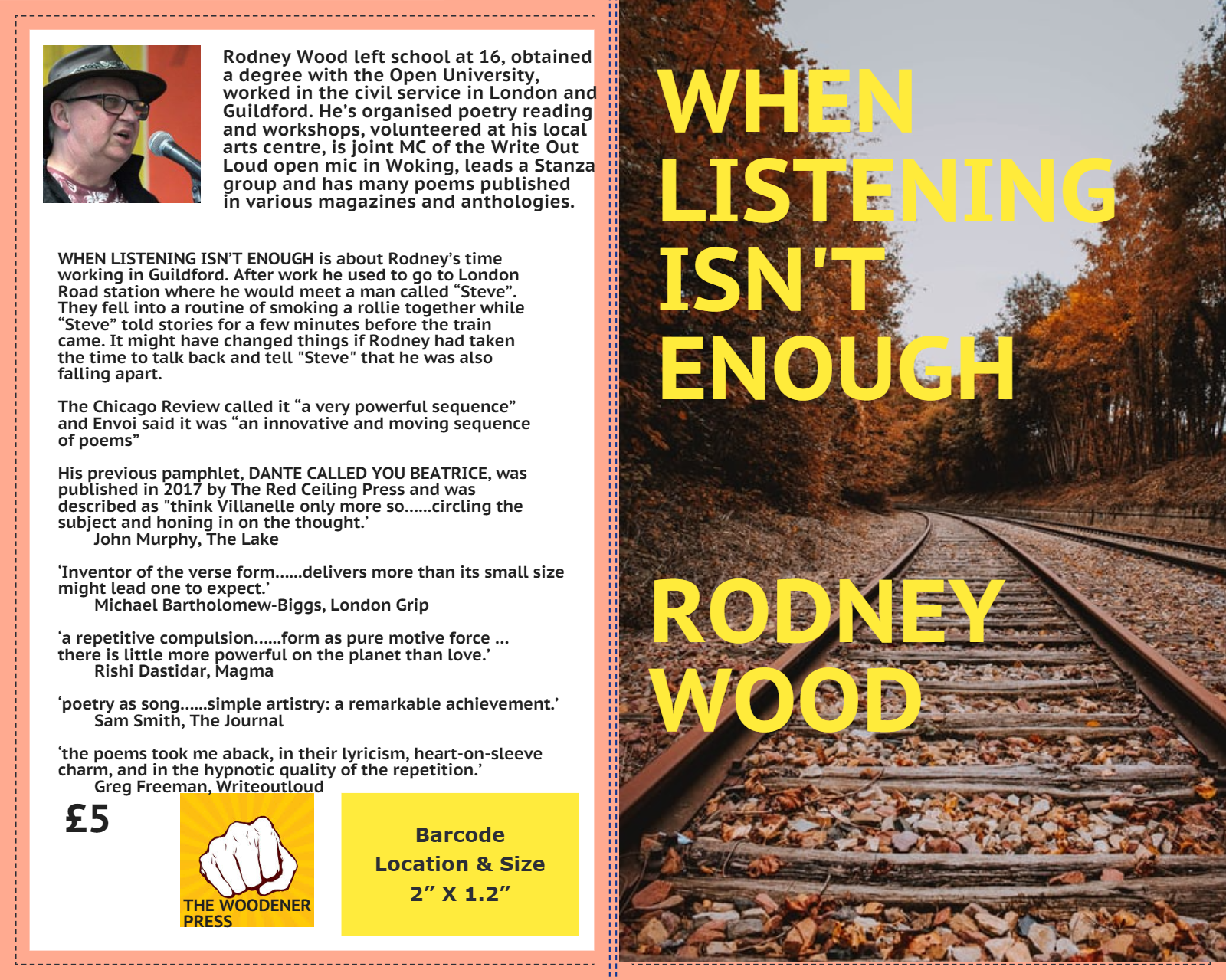
The cover had to be updated to include the logo for “The Woodenpress” and the price the book would retail at. I could also take the opportunity to fiddle round with the formatting after I’d looked at other pamphlet publications. I thought this would be a long tedious process using some Adobe software I would have to pay for and spend ages learning. How wrong I was. KDP allows me to download my own cover and helpfully provides a template. I downloaded this onto an online site, Sejda.com, where I was able to download photos, add text and save as a PDF. It took an hour and the new cover is ready to print. KDP automatically inserts to barcode for you.
When listening isn’t enough: Rodney Wood, Independent Publishing Network
by Carla Scarano D’Antonio
Friday 23rd April 2021 8:50 am
Rodney Wood’s second pamphlet is an original and powerful sequence of 21 poems about a challenging time the author experienced, his own difficulties interweaving with stories told by ‘Steve’, whom he meets at a railway station after work.
Wood’s poems have a performative style that fits well with his role as co-compere of Write Out Loud Woking open mic and as leader of Woking Stanza group, where he runs workshops. His poems are characterised by keen observations expressed in striking fresh images that convey an unexpected view; revelations of sorts that always surprise the reader.
the train turns down an unknown track / become clouds / forks of lightening
(‘Bewildered’)
tears leaving my eyes like falling fruit / I was alive but nothing made sense
(‘Seeing himself’)
outstretched arms heavy with tears / the white fluid of compressed vertebrae
(‘Good enough to bury’)
Such epiphanies interweave in the conversation with a stranger who becomes his alter ego, a companion in an infernal journey. The innovative use of language recalls the situation the protagonist was experiencing at the time, and the problems of ‘Steve’ – his addictions, sense of failure, and depression:
under the obvious & meaningless sun / the cage & weeds / of London Road
my wounds have yet to heal / under the obvious & meaningless sun
my wounds have yet to heal / the cage & weeds / of London Road
(‘Cherry Methanol & Liquorice’)
I’ve known pain without end / I don’t want an immortal soul / I wanna die
I’ve never been human / I’ve known pain without end
I’ve never been human / I don’t want an immortal soul / I wanna die
(‘Youth’)
In this atmosphere of dejection and emptiness, “in a world of appearances”, Dante’s Inferno is evoked in the figures of the damned, who are “buried to the neck”; they are the damned souls in the Caina, the traitors to relatives whose punishment is to be buried in different positions in the iced lake of Cocytus. The literary reference is probably not related to the sin but rather to the condition of being damned forever and to the harshness of the punishment. In contrast to Dante’s Divine Comedy, in Wood’s sequence there is no positive progression, reconciliation or redemption. The poems trace a cycle in which the end reiterates the beginning:
the weight of London Road / at the end of the platform / with a leather hat
Steve’s walking in circles / the weight of London Road
Steve’s walking in circles / at the end of the platform / with a leather hat
(‘Watching from the Bridge’)
Physical decay affects the final poems in a world that is indifferent to the protagonist’s terrible situation. Listening isn’t enough; we cannot turn our head away – we need to be involved, empathise and find solutions in order to save people’s lives.
Wood says that ‘selling the book is not my priority’ and that he is giving the book away to people he admires and to friends or is swapping it for a different book. The profits from any sales will be donated to national charities such as the Samaritans that work to help people in difficult situations. This is a compelling sequence that contributes to the awareness of the human condition by raising a flag for the unlucky ones and revealing how far we can go when desperation hits.
Getting the book printed didn’t take very long and in fact took me by surprise. It’s on Amazon now. https://www.amazon.co.uk/WHEN-LISTENING-ENOUGH-Rodney-Terence/dp/1800494602 but the book entitled “Action Steps for Expository Preachers” was written by another Rodney Wood. Selling the book isn’t my top priority. It was always my intention to give the book away to people I admire, friends or engage in “swapsies”. So I haven’t got a Facebook author page, use Twitter, Instagram or worried about Bookbub, the cream of the crop apparently when it comes to promoting and marketing your book. I do however like the idea of creating a Youtube channel where you can hear the poem and see me wearing that leather hat. I already seen to have started a blog but haven’t set up a link to my Amazon page and really tried to push it. When I get the books I’ll send some off to reviewers, although my first book was received 5 positive reviews that resulted in no extra sales. Two copies will of course be sent to the Poetry (and they’ll probably pay you). The point is I’m very relaxed about the whole affair. So far this has resulted in an article in Write Out Loud. I’ve also had the idea of donating any profits to a national charity but more about that in another post. However, I’m still waiting for copies of my book to arrive and then I have to buy envelopes, and stamps. To end here’s the second poem in the book:
YOUTH
I was bruised with bamboo canes / knew nothing much for sure
slept on boards / wore chains / I was bruised with bamboo canes
slept on boards / wore chains / knew nothing much for sure
I started cruising until / another day / another demon came along
escaped from the closet / I started cruising until
escaped from the closet / another day / another demon came along
I waited in the park for business / I couldn’t forgot that childhood
joined with a pimp / I waited in the park for business
joined with a pimp / I couldn’t forgot that childhood
I’ve known pain without end / I don’t want an immortal soul / I wanna die
I’ve never been human / I’ve known pain without end
I’ve never been human / I don’t want an immortal soul / I wanna die
‘Self-publication? It’s a perfectly respectable way to get your book into print’
by Rodney Wood
Friday 12th March 2021 7:13 pm
Rodney Wood is a long-time poet and co-compere of Write Out Loud Woking. He recently decided to investigate how difficult or easy it is to self-publish your own pamphlet. Here’s how he got on:
“After you’ve been writing a while and sending poems off to magazines you obviously think of the next step, a pamphlet. You try competitions and sending to publishers who may or may not respond. It’s a lot of work, not only finding the right 20 or so poems but also writing about your poetry ‘experience’. For whatever reason, no one was going to take my poems.
What’s my pamphlet about? When working in Guildford I used to meet ‘Steve’; I never found out his real name. We fell into a routine of smoking and ‘Steve’ would tell me stories about his life. It ended when he committed suicide. All the poems share the same looping pattern.
Visiting printers at the moment is out of the question, so if you want to be involved in the process that means print on demand. The advantages? There are no upfront costs, it’s simple, quick and relatively cheap. Self-publishing has been around for years (Virginia Woolf did it, as did Mark Twain and James Joyce. William Blake did nothing else). It’s a perfectly respectable way to get a book into print.
The process is quite simple and you can redo, if necessary, any one of the stages. The first step is to have the poems ready in Word format (DOCX). Go through them and get friends to go through them to check for typos. At the front of the document I manually added the contents list together with the page numbers on each page. I saved the file in Word format but it could just as easily have been in DOC, HTML or RTF. In order to get an idea of the overall process read, or print out, the Amazon KDP: Complete Guide to Kindle Direct Publishing (Step-by-Step). I was only interested in a print version – I don’t like the look of poems on a Kindle. I did a mock-up at this point of how I wanted the book to look including the cover, back cover, copyright page and dedication.
The most difficult thing was coming up with the name of the publisher. Ace Press, Aldershot City Press, Applewood Press, Arcadia Publishing, Pond Books, Autumn House Press, Bruyno Press, Beacon Publishing, Bonnier Little Press, Book Publishing Of Farnborough, Bright Skies Press, Little Wood Press? I could have spent weeks trying to think of names. Instead I joined the Independent Publishing Network to solve this little problem, using their name as my publisher. It also gave me an ISBN number, but Amazon can give you this for free anyway.
For the font there was a straight choice between something unfussy and easily readable, Arial or Times New Roman, or else the more interesting looking Garamond, Didot or Perputa. I chose Arial in the end. A size of 8 or 9 point worked fine.
Most pamphlets I have are the same size trim size of (5”x8”). It’s a good idea to change the page size of your Word document to fit this size, and don’t forget to change the margins.
KDP has a Cover Creator tool which proved sufficient. I had already chosen a photo for the cover and I was given a number of different templates for the style and layout.
At this point I could preview and go back to make necessary changes. When I was finally happy I pressed Save and Publish and 12 hours later my book, When Listening Isn’t Enough, was listed on Amazon. I ordered a proof copy to check what it looked like: £1.70 printing costs plus £2.84 postage. The cost of 50 copies of the 24-page pamphlet, including the proof copy, was £95.25. So now I must order 50 copies for myself to swap or sell. And then comes the marketing stage …


 Rodney Wood