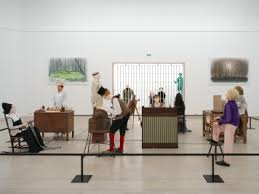
MONDO CANE

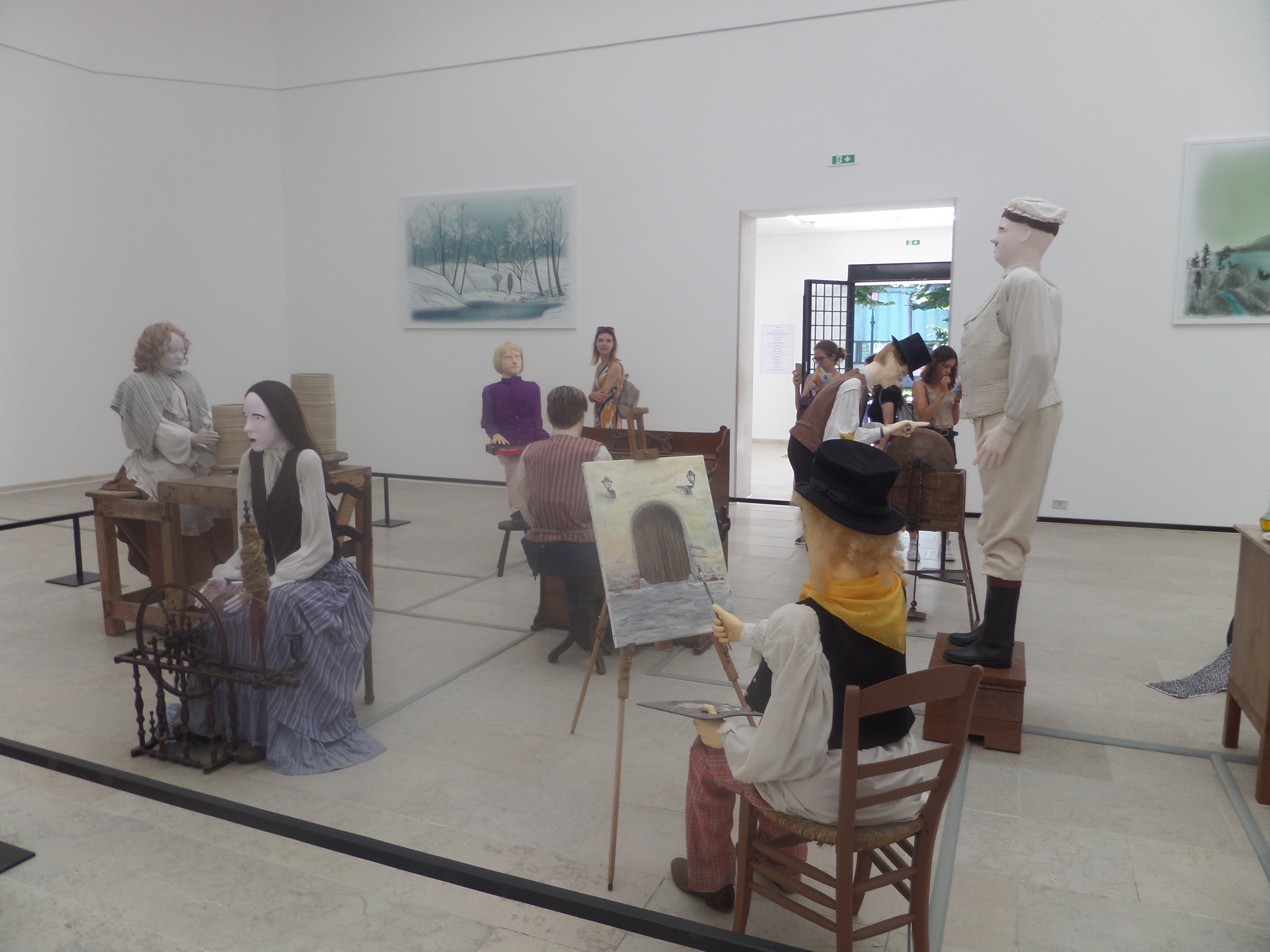
by Jos de Gruyter and Harald Thys at the Venice Biennale. It’s a display of the human condition. The exhibition features a group of automated puppets set amongst a series of large drawings of pastoral scenes and steel grids that fence off the pavilion’s lateral recesses. Some of these puppets are craftsmen – a musician, a shoemaker, a knife grinder, a spinner – who faithfully exercise their respective skills. It is a utopian world, pure and clean. Around the edges is a parallel world filled with rogueing zombies, poets, psychotics, and dropouts. These two realities coexist in the same space, but appear unaware of one another. They do not touch and this segregation is evident. The pavilion acts as a true promenade, similar to a touristic or anthropological experience reminiscent of an older Europe. Of course what interests me is the poet behaving in ways that are expected/unexpected.

SAMSUNG CAMERA PICTURES

MAY YOU LIVE IN INTERESTING TIMES

I was lucky enough to visit the Venice Biennale last Sunday and wentr to the Giardinio and Arsenale. It’s quite overpowering 5 and a half hours looking at art from names who are totally unfamiliar. I won’t go through them all but the tone was set with the Belgium display by Jos de Gruyter and Harald Thys. A display of automated puppets some of whom in the centre represent an ideal world (craftsmen, muscians etc) and other around them from the real world behind bars (poets, dropout, zombies etc). In additional each character is given a mini biography which made me think that we all live and are true to our own stories. It’s like an anthropological experience of an older and utopian Europe. https://artreview.com/previews/2019_venice_questionnaire_jos_de_gruyter_and_harald_thys_belgium/

THE WEATHER IN NORMAL/LIGHTBOX

Thursday saw me catching the bus into Guildford (and seeing Paddington Bear) then train to Woking for another Open Mic at The Lightbox. 18 people in all, come to read their poems and listen to Patrick Osada.  Greg Freeman did the honours in the first half while I did the packed  second half and almost got carried away thinking of AA and the poets sitting around sharing their poems/stories.  We finished with time to spare with a few poems by Kitty Coles. I enjoyed very much both hearing the poems and talking with those attending.

The next night I travelled to Waterloo and stopped off at the Poetry Library to get some books and look at a reconstruction of WS Graham’s cottage and workplace.W Then onwards  to The King & Queen for the London launch of Carrie Etter’s fourth collection, The Weather in Normal, with guest readers John Clegg (who introduced proceedings), Kathryn Maris, and Jane Yeh. I sat in the front row and noticed that the person next to me had the same book I’d just borrowed, it was Kathryn. We talked until it was time for the readings.  Kathryn and Jane had two poems each while the lovely Carrie had 10 mins and read brilliantly with emphasis on space and pacing. After that was able to catch up with Susie, wave at Tammy, Jill, before talking to Carrie.

Questions after of course but they had in common an active social side and a love of sharing poems

.

TRILOOP

  • each line has two or more parts
  • each line has a break somewhere near the middle
  • each stanza contains three lines
  • each poem can contain any number of stanzas

It can be demonstrated as follows where A, B, C are three successive phrases that make a sentence or stanza and are repeated exactly as follows-

line 1: B+C

line 2: A+B

line 3: A+C

never going to be loved or adored

                                                                like an exquisite keyboard

a xylophone of bones

                                                               never going to be loved or adored

a xylophone of bones

                                                                like an exquisite keyboard


FREE VERSE

22 September at Senate House in London. Saw Susie Campbell outside Poetry Library. Went the wrong way past the British Museum luckily bumped into Anna-May, sidetracked when I arrived into reading with Tami. Hall much bigger and good room for readings. Shame it wasn’t in the programme (just the name of the publisher). Like meeting FB friends-Todd Swift (send him poems on Tuesday), Greg Freeman, Clare Saponia, Tim Ades, Adam Horowitz, Dino Mahony, Jeremy Page, Michael Bartholomew-Biggs. Arrived at 11 and left a few hours later with too many books.


My Few Don’ts

Here are a few I found that make sense –

  1. Don’t assume that free verse, now the default mode of poetry is equivalent to the practice of cutting prose into lines. Greeting cards, advertising copy, political and cultural mantras are split into lines as well.
  2. Don’t take yourself so seriously. In the age of social networks, of endless information and missinformation, “sensitivity” and the “true voice of feeling” have become the most available of commodities.
  3. Don’t underestimate the importance of a sense of humour, of irony. Remember that satire, mock-epic, and burlesque are hardly inferior forms of poetry.
  4. Don’t do what everyone else is doing. Create your own form.
  5. Don’t think you’re special.  Don’t think you’re the only one who’s ever suffered.
  6. Don’t think what you have to say is important. The way you say it is what’s important. What you have to say is rubbish.
  7. Don’t think you don’t have to read. You read in order to steal. Read more, steal better.
  8. Don’t write to please others, write to please yourself.
  9. “The mastery of any art is the work of a lifetime…poetry is an art not a pastime.” Ezra Pound
  10. Don’t be bored, don’t be lazy, don’t be trivial, and don’t be brown and don’t be proud. The slightest loss of attention needs to death. Frank O’Hara, 1964
  11. Be honest. Otherwise, what’s the point?

THE BLACK DEATH

I’ve sorted poems out to make a sequence but have never written one from scratch so in May I started the journey. I was reading about The Black Death in “The Time Traveller’s Guide to Medieval England” by Ian Mortimer and it struck me how people were the same then as now. The main idea was to pick a current news item, write a poem about it and preface it with an item about the Black Death. Then I got distracted because I could also write a poem about what happened during the Black Death and preface that with a current news story. Or are they the same? Anyway, they all follow the same form – my (still unnamed) 3 line verse form in 4 stanzas. In August 50 poems later, I started to send them out. So for 4 magazines have rejected them, 2 have accepted and 8 are outstanding

BOOK LAUNCH

I’d been to many launches in the past at the  Poetry Society and it would make me feel legitimate. Kitty Coles also had a book coming out at the same time so it seemed like a good idea to share the cost of the room. Thought we should have some guests as well to make the evening more stimulating. WOL reviewed the night.

No sweat, it’s cool: verdict on new-look Poetry Cafe as pamphlets are launched

entry picture

This is a picture of a happy audience in the new-look basement of the Poetry Café on Saturday night. There’s no doubt that the old downstairs at the Poetry Cafe in London had a ragamuffin identity – and aroma – all of its own. There were those who loved its sweaty ambience, although I was not one of them.

Maybe there will be some who lament that something has been lost amid the bright white surfaces of the new-look café, upstairs and downstairs – an expensive refit by the Poetry Society that has taken the best part of a year to complete. But an atmosphere is not just its surroundings, it is the feelings and inter-action generated by quality poetry and an appreciative audience.  And judging by the bonhomie engendered on Saturday night, the new-look café is already a hit.

embedded image from entry 70300

We were there for the joint launch of pamphlets by Rodney Wood and Kitty Coles, pictured – both regulars at Write Out Loud Woking. (Rodney is co-compere). Their readings were preceded by contributions by guest poets – Melanie BrantonMaggie SawkinsGrant Tarbard, and myself.Melanie was first up, her performance, as befits a slam champion, delivered without any reading aid, and laced with witty “syntax evasion” wordplay. There were also strong fairytale elements – of which, more later – including a poem about a gingerbread house, written from the witch’s viewpoint.

Award-winning poet Maggie Sawkins read several poems from her collection Zones of Avoidance, including one about a night when she interviewed her favourite band, another from the point of view of a stone, and ‘A Dog Asleep in the Crook of your Arm’ – the title says it all.

Second-half guest poet Grant Tarbard used to edit a well-loved print and remarkably illustrated online magazine The Screech Owl, both before and after he suffered a stroke that left him in a wheelchair. His poems on Saturday night included ‘Triptych’ – “I have had three deaths, / one for each decade” – and ‘Body’ (“I have been a life without a body / sitting slumped in silence and imcomplete”. They are included in his newly published Rosary of Ghosts, to be launched at the Poetry Cafe next month. The poems in it have been described by Martin Figura as “threaded through with pain; the gentle and abiding love in them carries us through”.

I felt obliged to include a poem about Waterloo station in my guest-poet set, given the struggles some poets and audience members had had to get to Covent Garden, thanks to the ongoing improvements at the London terminus that were meant to have been completed by the end of August, and are now continuing at weekends until the end of November …  but don’t get me started.

embedded image from entry 70294

The final poet of the evening, Rodney Wood, pictured, was a revelation. As co-compere of Write Out Loud Woking, I reckon I know him fairly well, and am acquainted with the tercets he often writes involving repetition of lines and phrases – a style I believe he has initiated, and has dubbed his “little poetry machine”. But the said tercets in his pocket-sized, limited-edition chapbook Dante Called You Beatrice took me aback, in their lyricism, heart-on-sleeve charm, and in the hypnotic quality of the repetition, which works both on the page, and even more so in performance.Rodney is a poet that has been around for a while, and consequently seems to know almost everyone on the poetry scene. In his introduction he spoke of the generosity that he has found and valued in the poetry world – and he was certainly generous in his introductions to his fellow poets on Saturday night. It make me realise that what can be lacking at some launch nights is someone to introduce the launch poets themselves – and hopefully this review can partly make good that omission.

In that regard I must also pay tribute to the qualities of Kitty Coles, a younger poet whose name pops up very often in poetry magazines. She was launching her pamphlet collection Seal Wife, which was joint winner of last year’s Indigo Dreams poetry pamphlet competition. Her gothic, unsettling poems using stories and characters taken from fairtytales and myths create a particular world. Her style is cool and controlled, even if the subject matter is the darkness on the edge of town. They are poems that are outside the comfort zone; that is their point.

She disclaims any autobiographical element. Introducing one poem, ‘Black Annis’, with its references to “rag and bone”, and “gowns of skin”, Kitty said: “People can’t possibly think this poem’s about me.” She described another, ‘Peter the Wild Boy’ as “the only one that has a tenuous link with real life”. Other titles included ‘Poltergeist’, ‘Osisris’, ‘Banshee’ and ‘Forest’. We will be hearing more from her, and about her, and one day be saying: “Kitty Coles? She used to read at Write Out Loud Woking, you know.”

As we walked back past the anti-terrorism barriers on Waterloo bridge afterwards, I reflected again on the changes at the Poetry Café – smart new toilets, and extra space in the café upstairs, too. And Grant Tarbard’s verdict on the access facilities? “The only addition to what was already there (disabled toilet and a lift, which are fine) is a slightly awkward ramp. At least it’s a small improvement – and it’s the only poetry venue that I know of in London that’s fully accessible.” From today (Monday 18 September) the Poetry Cafe is open from 11am, Monday to Friday, and on some Saturdays, too.

Greg Freeman
THE BOOK ARRIVES

Early August Mark, The Red Ceiling Press, sent me a PDF copy to look through for typos/formatting corrections. I found a few of those and made a few changes myself. After 5 attempts it was signed off on the 6th and I could go on holiday for two weeks. On 1 September 50 copies of the booklet arrived and are sitting beside me. Before the hols I was also thinking about the launch. London I thought, maybe the Poetry Cafe. It so happened that a friend, Kitty Coles, also had a book coming out at the same time. We pooled resources and got the Cafe (£65 for 2 hours) which would be handy for people to get to. We didn’t fancy spending all that time reading ourselves so thought about having friends reading. Greg of course, and Grant (who also has a book coming out and is disabled – Kitty works for a disabled charity). Kitty choose Melanie Branton (a friend of Robert Garnham) and Maggie Sawkins (also known and loved by me) – poetry is a small world. On 1 September it arrived in a sealed plastic envelope.  Had a few drinks that night. Next day posted some copies off for review. I posted Raul a few copies to Mexico City, a few days later there was an earthquake, just saying.

CHAPBOOK BLURB

My first preference is for none at all but then I thought maybe I should put down something about myself that shows I’ve been active in the poetry bubble. But should I also say how my little poetry machine works? A friend answered he was more interested in the end result rather than a Haynes type breakdown as to the process. No then.  I have a couple of nice things some poetry mags have said about my poems so why not take them out of context and use them? I thought about Arthur Smith sending me an email – well done that man. I could have sent it out to friends of course but that can wait for a collection. The title of the chapbook comes from a book by Paul Potts (no, not that one), perhaps the most romantic book I’ve ever read. A few relevant quotes. Anything else? The cover. The final choice was a painting by Raul Cordero whose work I first saw when on holiday. I liked the three part structure, what was said and unsaid, the missing parts and the ghosts. There had to be some legal stuff about permission to use the painting.


Rodney Wood

Lives in Farnborough. He left school at 16, obtained a degree with the Open University, worked in the civil service and retired early. Since then he’s organised poetry reading and workshops, volunteered at his local arts centre in Aldershot, and performed in various venues, including the South Bank. Recent work has appeared in or is forthcoming from publications including Brittle Star, Envoi, The Journal, Magma, Prole, South, Stride and Tears in the Fence.

His work has been described as “innovative and moving” by Envoi and “powerful” by Chicago Review

A lover that is not loved is a river which can never get to the sea…you have no more right to ask me to fall out of love with you than I have to expect you to fall in love with me.” Paul Potts

Cover by RAUL CORDERO “Per la vostra sicurezza”

2000. Oil and polyester on canvas

200 x 140 cm

Private Collection, New York

Photo courtesy of Raúl Cordero Studio and Mai 36 Galerie