Postcards From the Floating World: Letting the Poems Go

For a long time, these poems lived in notebooks and drafts, jotted down each day aboard a ship circling the world. They began as small postcards to myself—10-line dispatches from the deck, from memory, from wherever the sea carried us. Over the past year, I’ve revisited each one, sometimes gently, sometimes with a scalpel, trying to listen for the real voice underneath. My voice.

Some poems didn’t make the final cut into the collection. A few felt too similar in tone or subject to others, some didn’t quite carry the same voice as the rest of the collection, and a handful, let’s be honest, were probably beyond redemption. But I’m not concerned. They could be replaced easily enough by my stories of previous cruises of events I would have talked over with our little group of friends we chatted to every night.

I’ve edited every poem now. Not just for line breaks or punctuation, but to be sure each one sounds like me. That they belong to the same world. That they carry the tone I meant, even when I wasn’t sure what I meant at the time.

DAY 83: EPITAPH FOR A DAGGA BOY (CAPE TOWN)

    Mark, our guide, eases the jeep to a gentle halt,
    and we fall quiet where old bones sprawl,
    brittle edges breathing dust and dried blood,
    sun-baked marrow, silence thick as heat.

    A buffalo’s ghost still lingers here:
    its hooves once thundered the open plain,
    its breath defied the wind’s sharp reply.
    In its prime, a match for anything wild.

    Vultures pirouette the sky above
    in a slow, macabre ballet of wings.
    Ragged feathers rasp against dry air,
    like sandpaper drawn across a drum.

    Their shadows reel across cracked, red earth.
    Hyenas skulk just beyond the scrub,
    their laughter splits the afternoon wide open
    like a snapped femur, white and unclean.

    Mark surveys the scene, his brow furrowed tight.
    “Looks like this old Dagga Boy,” he says,
    “couldn’t keep up.” His voice dips, softening
    the way it does with what can’t be explained.

    “He picked a good spot by the river’s bend,
    golden grass, mud baths, the works,” he says.
    “A buffalo’s kind of retirement.
    No golf carts though, ja?” His smile flickers,
    fading as he stares down at the bones again.

    “Had a decent run, I’d reckon,” he adds,
    leaning back with a slow and satisfied creak.
    “Stood his ground, maybe found love out here
    beneath the thorn trees, in the dry season.”

    The jeep roars again, kicking up old dust.
    We lurch forward, heat waves curling ahead,
    leaving the skull grinning in our wake
    as if it knows something we’d rather not.
    Another mile, another hour slips by,
    closer to whatever waits in the grass.

    The next step is to begin letting them go.

    I’ll be sending them out in small batches, one a week, to magazines that might welcome them. I don’t expect a flood of acceptances, but I do believe these poems will find their way. Here’s a list I’m considering but of course there are many other magazines I want to submit to, and of course there are poetry competitions as well.

    Here’s a list of some journals I’m considering:

    • Atrium – Emotionally resonant, well-crafted poems that balance clarity with depth.
    • Bad Lilies – Bold, contemporary, often formally adventurous work.
    • Interpreter’s House – Thoughtful, image-rich poems with a narrative thread.
    • London Grip – Accessible, reflective poems, often subtly political.
    • Magma – Regularly welcomes travel-based or themed submissions.
    • New Ohio Review – Image-rich, humane poetry with emotional resonance.
    • Ploughshares – Prestigious but approachable for grounded, serious work.
    • Poetry Review – Ambitious, layered poems with strong, distinctive voices.
    • Rattle – Open to narrative, humorous, and heartfelt poems.
    • The Fig Tree – Visual, nature-inflected or spiritual poems.
    • The High Window – Lyrical poetry with an international or literary edge.
    • The Long Poem Magazine – Poems over 50 lines: narrative, meditative, or experimental.
    • The North – Intelligent, place-based, and reflective poems.
    • The Rialto – Original work with character and clarity.
    • The Seventh Quarry – Musical poems with international flavour.
    • The Southern Review – Place-rooted, quietly observant poems.
    • The Threepenny Review – Clear imagery, wit, and understatement.
    • Under the Radar – Emotional, precise, and accessible poetry.
    • Wild Court – Welcomes both lyrical and narrative work.

    I believe they should be published because they speak to experiences many people share but don’t always talk about: the strangeness of time at sea, the joy of small rituals, the weight and humour of memory, and the quiet ways we carry grief and love. They’re not grand or showy, but they’re honest. And sometimes, honesty travels furthest.

    Publishing in magazines isn’t just about recognition, it’s about giving them a place in the world beyond my notebook. Letting them speak to someone else, as they once spoke to me.

    After so long living with them, the thought of sharing them feels both unsettling and necessary, like watching something you’ve grown used to keeping close begin to take its own shape and life elsewhere.

    If you’re reading this and know of magazines or journals that might be a good fit, feel free to suggest them as I’m open to surprises.

    Thanks for following the journey so far. I’ll post updates as the poems begin to appear, if and when they do.
    Before You Hit ‘Send’: A Poetry Completion Checklist


    After writing and revising over a hundred poems for my cruise collection, I realised I often forgot the same basic things—especially when I was close to finishing a poem. So I made this checklist to help me decide when a poem is done. Or at least ready to be read aloud or sent out.


    Poetry Completion Checklist

    At each revision stage, here are some of the questions I sometimes forget to ask myself—but should:

    Does the poem have a single, clear central idea or theme?
    Are sensory details present to help readers see, hear, and feel the poem’s world?
    Is the point of view consistent? (Shifting POV can confuse, unless it’s intentional and clearly handled.)
    Are the tenses consistent throughout?
    Does the poem evoke the emotion I intended?
    Is the structure logical and coherent?
    Have I checked spelling and grammar carefully?
    Are homophones and typos corrected?
    Are the images and metaphors clear, vivid, and effective?
    Am I showing rather than telling? (Does the poem evoke emotion through language and imagery?)
    Does it still feel authentic and true to my voice?
    Will the poem connect with a reader’s emotions, memories, or curiosity?
    Does the poem still surprise me?
    Is there a reason for the reader to care?
    Is the rhythm consistent, and does the poem flow easily?
    Is there any awkward phrasing?
    Are there any unnecessary words or lines that don’t add anything?
    Have I read it aloud to catch any clunky bits or flat patches? (Reading often reveals things I don’t see on the page.)
    Is everything clear enough for a reader who isn’t me? (What’s obvious to me might not be to someone else.)
    Am I revising to improve the poem or just out of habit or fear of letting it go?

    That’s already a long list and there are always more questions. But after I’ve been through this process (sometimes too many times), and I think the poem might be finished, I still ask myself a few final things:

    The Afterthought Stage

    1) Would I be happy to perform this poem to an audience, at a reading or an open mic, or send it out to magazines?
    There’s nothing worse than reading a poem you thought was brilliant and realising halfway through that it’s not working.

    2) Have I revised this poem so many times that I’m now just producing another version of the same thing?
    Not better, just different. Like Monet’s 25 versions of Haystacks—sometimes the changes are variations, not improvements. I’m no longer making real progress, just rearranging the same ideas.
    me spot what’s missing or give me permission to stop editing and let the poem go.

    Every poet needs their own process and I’ve found that having a checklist like this helps me avoid finishing too soon or revising forever. In the end, it’s about finding the balance between control and letting go. And trusting that, even if this version isn’t perfect, it’s the one ready to meet the world. My cruise poems are now ready.

    When the Poem Fought Back: On Revision, Rejection and Cricket

    Some poems fight you every step of the way. This one did—from its first draft to its final line. It began with toast Frances couldn’t eat.

    Not the sandwich at lunch, not the biscuits with her tea. Coeliac disease had turned her world into a minefield of gluten, and that day in Singapore, everything seemed to contain the very thing that would leave her in pain and in danger of slipping into a coma.

    I started with a free verse draft, voice-led, trying to channel Frances’s experience directly. Her words, her frustration, her body’s rebellion against what should have been simple nourishment. It felt right to let the poem breathe in short lines, unforced, raw.

    I was pleased enough with it to submit. A few weeks later, it was accepted. Except, no contributor copy, no proof. Just an email telling me to buy the magazine if I wanted to see it in print. I’d found the callout on Facebook and hadn’t checked the fine print. My fault entirely. But it stung. I never bought the magazine, never saw my name on the contents page. Does that count as being published? I’m still not sure.

    Still, the poem nagged at me. Frances lives with real discomfort, daily limitations. If I was going to write about her experience, shouldn’t the writing cost me something? Shouldn’t I feel some of the tightrope she walks?

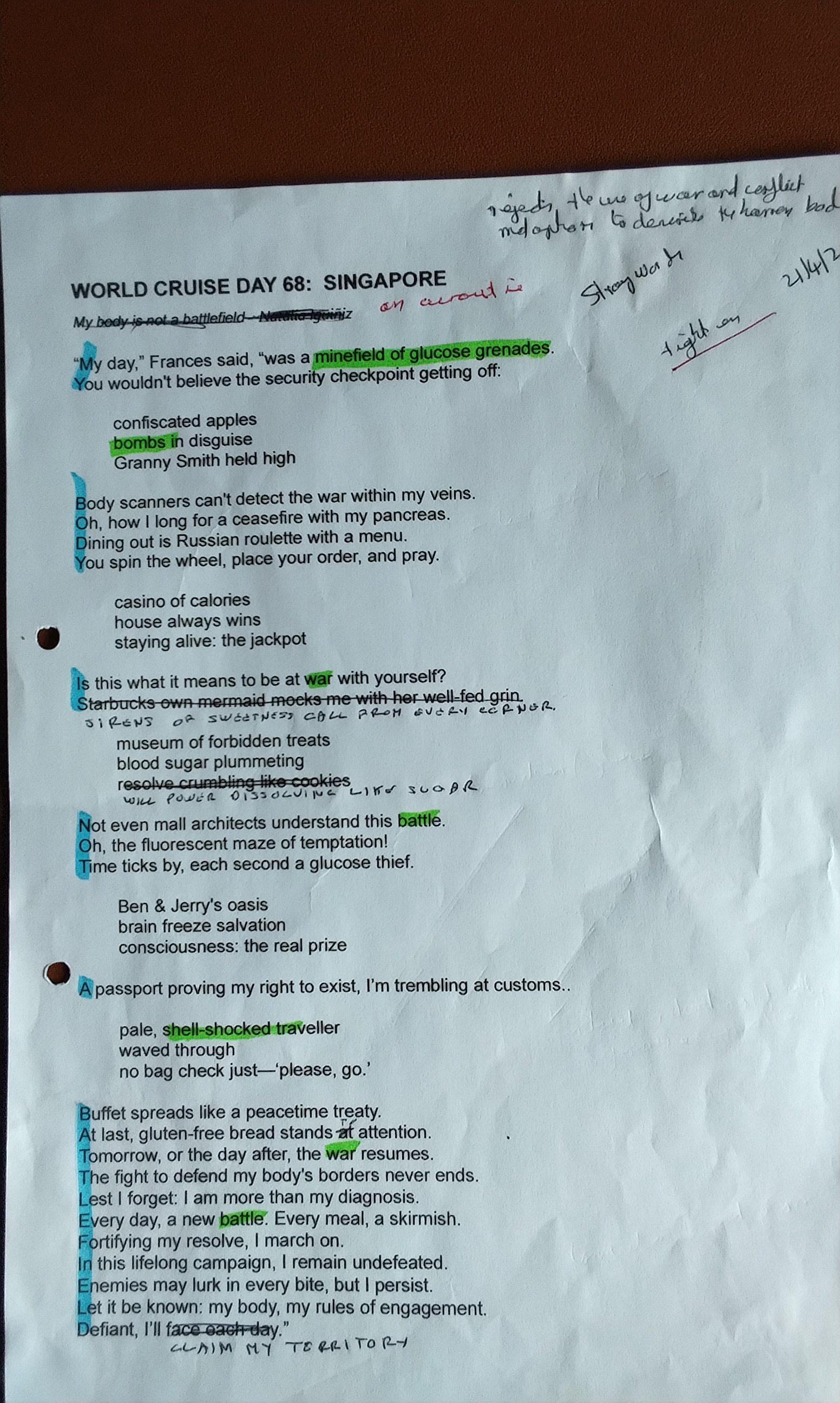
    I remembered one of her refrains: “My body is not a battlefield.” She hated the military metaphors people lazily applied to illness. I took those six words and built an acrostic around them, weaving five haikus between each one.

    It took weeks. I sweated over every syllable, every line break. The constraint forced me to slow down, to pay attention. I thought I’d finally created something that honoured her pain and the challenge of translating it into language.

    I thought it was brilliant. Others agreed with me. Frances didn’t.

    “It doesn’t quite work,” she said. And when I looked again, especially alongside other poems in my collection, I had to admit she was right. It felt strained: clever, maybe, but ultimately artificial. Like I was trying too hard to be poetic about someone else’s pain. Writing it was like breaking a leg; you don’t want to do it again.

    So I rewrote it. In my own voice, with my own metaphor.

    I played school cricket once, when I was fourteen. Scored 48 runs, half our total that day. I walked back proud, expecting a nod from the coach. Instead, he tore into me in front of the team: “Stop slogging the ball!” Despite contributing most of our score, I’d failed, apparently, to play the right way.

    That stayed with me. I played safe for a long while after that.

    So I wrote into that memory. Into the feeling of doing your best, getting it wrong, being misunderstood. Into the helplessness of watching someone you love suffer and not always knowing how to help. That was my way in. I couldn’t write her pain. But I could write about my place beside it.

    The cricket metaphor worked because it was mine. It carried the sting of remembered embarrassment, the complexity of good intentions gone awry. It gave me a way to be honest without overreaching.

    Sometimes, the best way to honour someone else’s story is to find the place where it intersects with your own. Even if that place is a cricket pavilion, twenty-five years ago, where a boy learned that effort doesn’t always equal approval.

    The poem still isn’t perfect. But it’s true in a way the others weren’t.

    DAY 68: TRAVEL IS LIKE CRICKET WITHOUT A BOX (SINGAPORE)

    Frances is coeliac and diabetic. Travel, for her,
    is like cricket: the rules are incomprehensible,
    the danger accumulates slowly, and eventually,
    something hits you in the gut.

    No food allowed ashore. An apple becomes
    a threat to National Security.
    We should’ve stopped at M&S, filled a bag with snacks
    and called them “religious relics.”
    Frances shrugs. “Typical. Obey the rules, go hungry.”

    We walk the bay, pass sushi bars, bubble tea kiosks,
    Hello Kitty blinking from neon signs.
    Frances says, “Beautiful city, but everything wants to kill me.”

    At Marina Bay Sands, cinnamon spirals
    from a doughnut cart, naan sizzles
    behind glass. She sits on a low wall,
    hands trembling like leaves.
    I pass her a fruit pastille. She chews without speaking,
    like someone trying to stay conscious through a sermon.

    Frances squeezes my hand, once, hard—
    for comfort, and to stay upright.
    Starbucks has nothing safe.
    Just posters smug with gluten.
    She sits beside a polished escalator,
    face pale, breath shallow.

    I’m rehearsing collapse, seeing her fall before she does,
    imagining the sound her skull would make on tile.
    We ride the subway to another mall—
    air-conditioned, endless, engineered to trap the weak.

    At passport control, the guard waves us through
    with a look that says just go.
    Her look says what I won’t:
    this is an emergency.

    Back on board, the buffet glows
    like salvation. She eats slowly.
    Colour returns to her cheeks like dawn.

    “I feel human again,” she says.

    I say nothing, but I think:
    God, I love her. Even if sometimes I feel
    I’m facing Fred Trueman and I’m not wearing a box.


    Finishing What I Started: From 10-Line Drafts to Finished Poems

    Sometimes you just need to finish things.

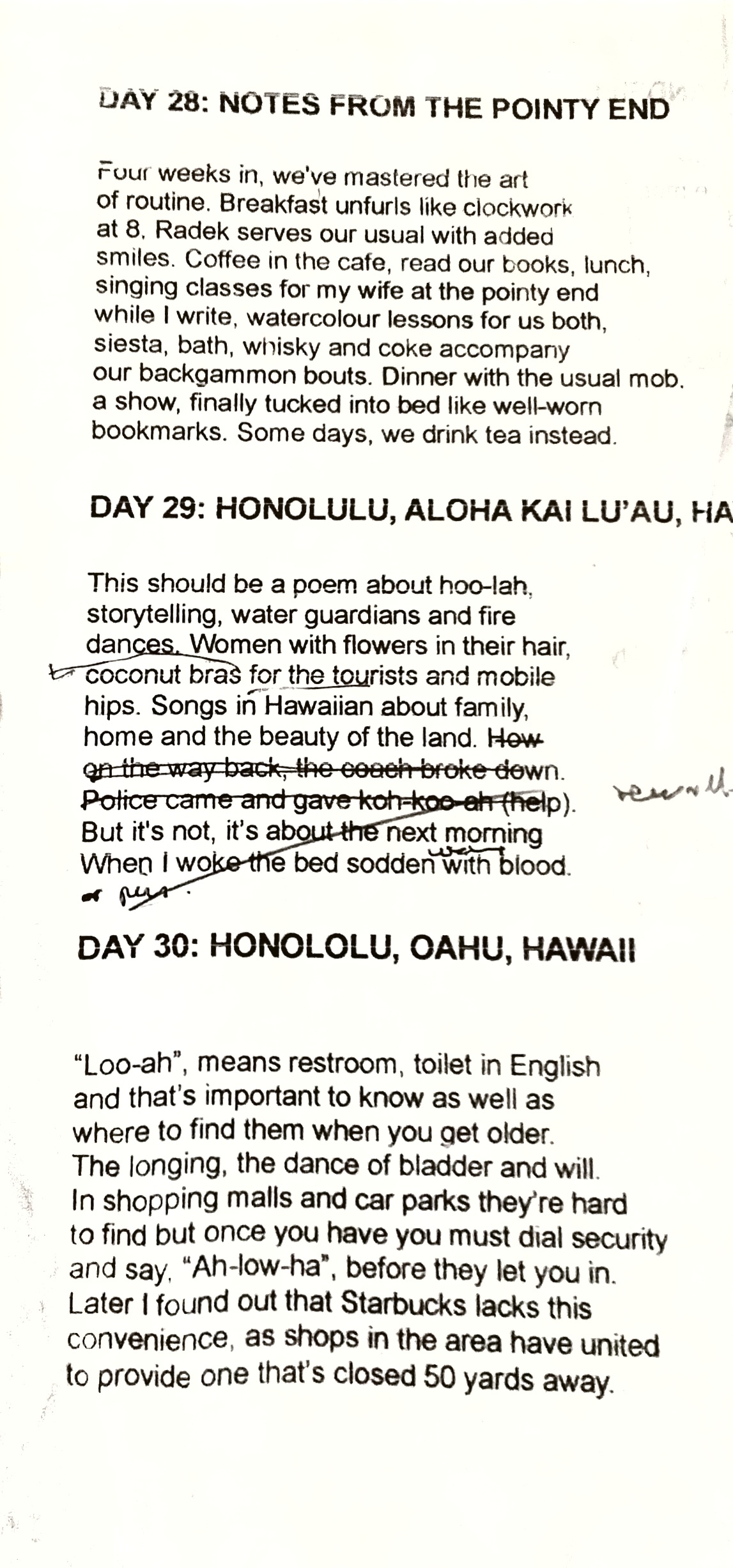
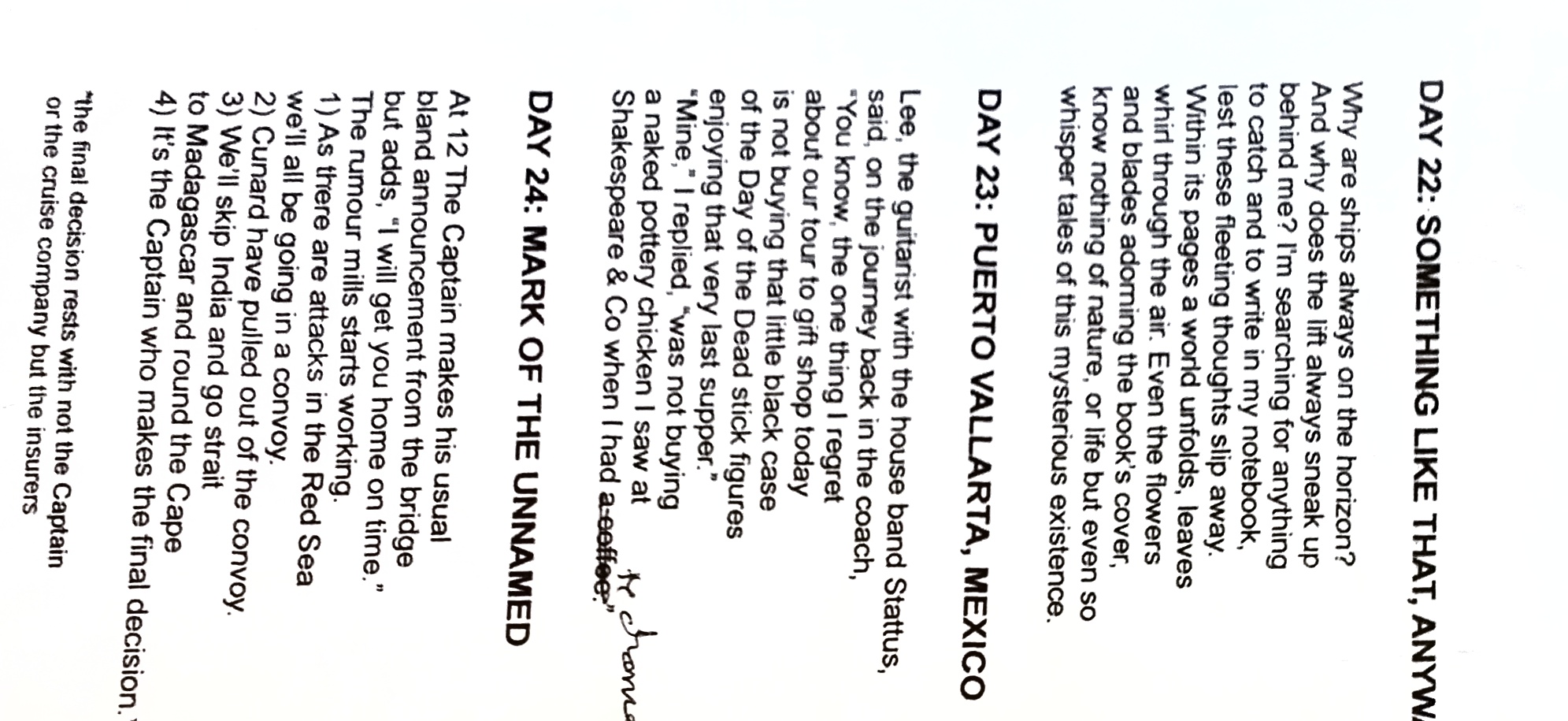
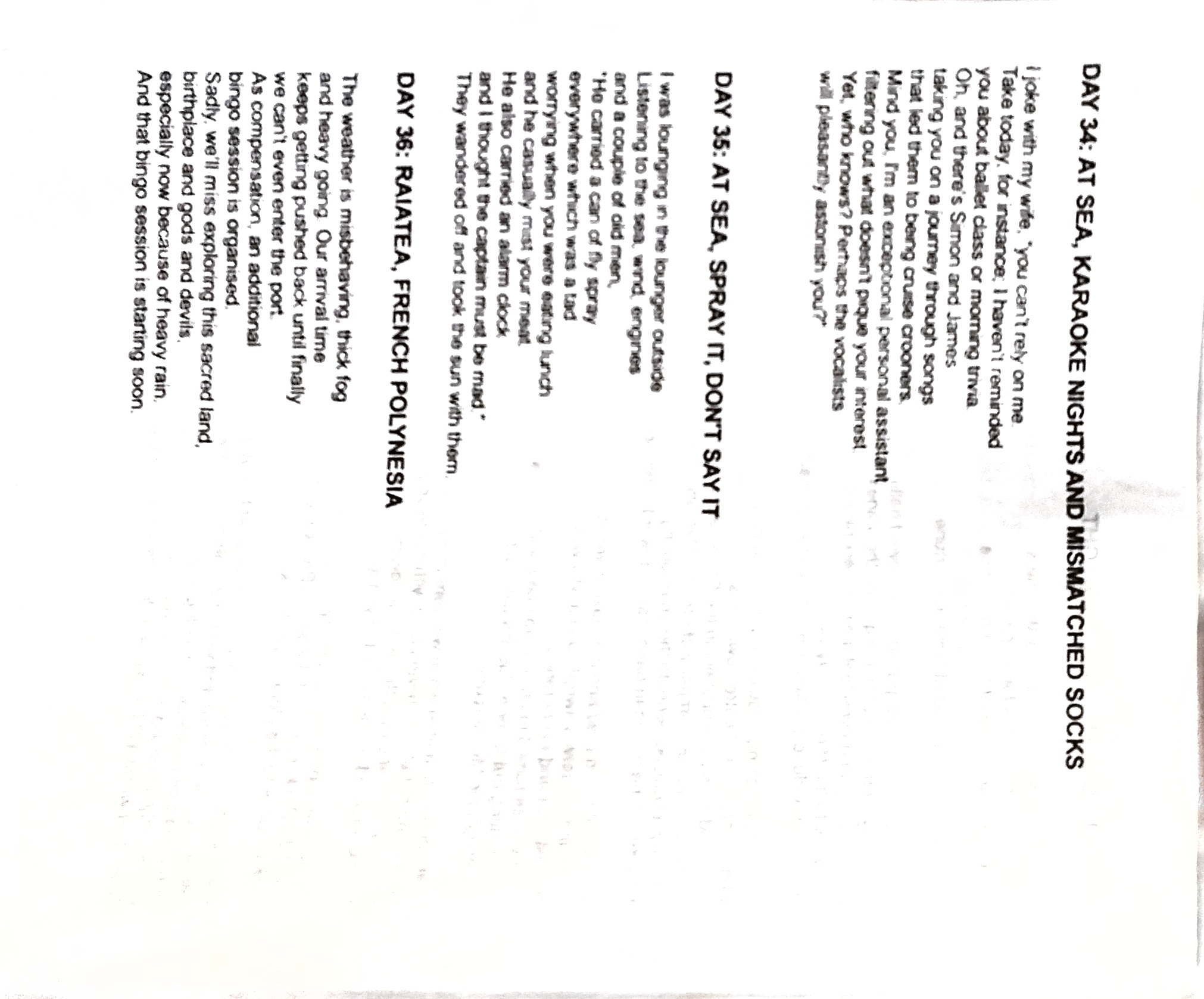
    During a 100-day project on a world cruise, I wrote a 10-line poem each day — small daily acts of observation, memory, weather, and whim. I used two notebooks: one to scribble down each poem, the other to transcribe the same poem in my best handwriting, as a kind of ritual, or record.

    I recently opened the second book and realised, to my dismay, it stopped at Day 57. For some reason, I’d never caught up. So I did what needed doing. Using Speechnotes, a speech-to-text app, I dictated the missing poems from the original notebook and pasted them in. Where that didn’t work, I simply cut out the handwritten pages and glued them down. Now, finally, I have a complete physical record of the process: 102 days’ worth of daily poems. One phase finished. And I could move on.

    Returning Home: The Shift Toward Revision

    Reading back over the poems surprised me. A few had a shape, an insight, a flicker of unexpected imagery. It turned out that doing something every day, even quickly, had taught me something. So I decided to revise all the poems — in order — from Day 1 to Day 100. I hoped this would give the whole collection a more consistent voice.

    I didn’t revise once. I went through them again. And again. And again — until each poem felt finished, or at least alive in its own right. This process took about 15 months.

    Some poems were sent out during the process and published (in slightly earlier forms) in Wildfire Words, The Lake, Morphrog, Fig Tree, Stray Words, The High Window, Poetry & All That Jazz, The Pomegranate (London), Seventh Quarry, and Black Nore Review. These small acceptances gave me encouragement — but also made me keep working, keep returning, keep refining.

    What I Learned in the Process

    The revision work was repetitive but revealing. I kept catching myself doing the same things wrong:

    Starting too early, and ending far too late.

    Leaving in lines that were clever but unnecessary.

    Getting overly emotional without clarity.

    Forgetting to say what I really wanted to say.

    And quite often, not sounding quite like myself.

    Some drafts were just awful — others were rewrites of earlier pieces. Still, the process of revision was where the real poems emerged. “First thought best thought” is a myth. As Ernest Hemingway said: “The only kind of writing is rewriting.”

    What Comes Next
    Now I have 100 finished poems. Not just daily jottings, but poems that feel like they belong together — as part of a single body of work. The next step is shaping these into a book. I’ve been thinking about structure, tone, voice, and how the poems echo each other. There’s still work to do, but it finally feels like a book is taking shape.

    And all because I went back to finish something I’d started.


    From Challenge to Creation: My 102-Day Poetry Journey

    I set myself an ambitious challenge: write 102 poems, one each day. What began as exciting quickly revealed its true nature – a test of creative endurance. As the days passed, the blank page seemed increasingly daunting. “Have I written too many poems about the sea?” I’d wonder, staring at the waves of words I’d already created.

    But this journey wasn’t about perfection. It was about determination and the discipline to show up daily, even when inspiration ebbed. The real achievement wasn’t in crafting flawless verses, but in building the creative stamina to persevere.

    After completing this marathon of words, I finally sat down to type them all – 102 poems capturing moments, thoughts, and evolution across seasons. Below are a few selections that mark points along my path.

    OUR PAINTING JOURNEY BEGINS

    Who knew that a simple 12-pan watercolor set could be a ticket to adventure, learning, and self-discovery on the high seas? In a moment of shared bravado, my wife Frances and I decided to embark on an artistic journey alongside our literal one. We purchased a 12 pan Cotman watercolor set, brushes, pencils, and paper, determined to have painting lessons every sea day during our round-the-world cruise.

    As we packed our new art supplies, a mix of excitement and trepidation filled us. Neither of us had any artistic practical experience, but we were eager to learn together. Before even setting foot onboard, we found ourselves thinking what to paint. Should we attempt landscapes of the ports we’d visit? Seascapes from the ship? Abstract interpretations of our experiences? The possibilities were as vast as the oceans we were about to cross. We set an ambitious goal: to create a painting for every port we visited – 35 in total. It seemed daunting, but we reasoned it would add structure to our sea days and provide a unique way to document our travels.

    Our lack of artistic confidence was evident, but we held onto the hope that by the end of our journey, we’d have not only a collection of paintings but also a newfound skill and perhaps a boost in self-esteem. After all, as the saying goes, “You have to start somewhere.”

    BENEFITS WE EXPECTED

    As we embarked on this artistic adventure, we anticipated several benefits:

    1. Creativity and self-expression: We looked forward to having a new outlet for our creativity. The idea of communicating our experiences visually, beyond just photographs, was exciting.

    2. Stress relief and mindfulness: We hoped that painting would provide a calming, meditative activity during our long days at sea. The thought of losing ourselves in the process of creating art was appealing.

    3. Cognitive stimulation: We’d read that painting could improve memory, concentration, and problem-solving skills. As we aged, the idea of engaging in an activity that exercised our brains was particularly attractive.

    4. Improved motor skills: The prospect of enhancing our fine motor skills and hand-eye coordination through painting seemed like a bonus benefit.

    5. Shared experience: Perhaps most importantly, we saw this as an opportunity to learn and grow together, sharing in each other’s triumphs and challenges.

    6. A unique travel record: We hoped our paintings, however amateur, would serve as a special memento of our journey, capturing not just images but emotions and experiences in a way photos couldn’t.

    As we set sail, paintbrushes in hand, we were filled with anticipation. Would we discover hidden talents? Would we find painting frustrating or fulfilling? Only time – and 35 blank sheets of paper – would tell.

    How I Wrote a Poem a Day on a World Cruise: When Reality Hits


    When I set out on a world cruise last year, I had grand ideas about how I would write a poem every day. I’d prepared notes, ideas, and prompts — all neatly tucked away in a folder. But as soon as Day 1 arrived, that folder was forgotten and it seemed a stupid idea.. The reality of the journey reshaped everything. Here’s how I approached writing those daily poems without feeling overwhelmed:

    One Day at a Time: The key was to treat it like I did when I gave up smoking twenty years ago when I was in New York — just stop smoking one day at a time, no stress. No hassle, it was something I could do, and it worked. So I never thought about writing 100 poems — just the poem for that day.

    Establishing a Routine: It took a few days at sea to settle into a rhythm. My wife, Frances, and I spent most of our time together, but there was one hour each afternoon when she attended her singing class. That became my designated writing time.

    A Quiet Space: I would follow Frances to the choir rehearsal, then find a quiet seat at the nearby bar (shut at that time of day) and write about the day before. I could turn my hearing aid off so it would be really quiet, although the bar was shut, a waiter would always come up to me and ask if I wanted a drink. This gave me a consistent place and time to reflect, get something down. My very first line was “the boat escapes under cover of darkness.”

    Adapting to Port Days: When the ship was in port, there were no singing classes — and no regular writing time. Instead, I found a second routine: a short poem during the 20-minute bath before dinner, capturing the day’s experiences and realising I was not an explorer hunting for new adventures but a tourist. There’s the excitement of seeing new places, but also the sense of being an outsider, observing rather than belonging. Some experiences were fleeting, while others left a lasting impression. The poems became a way to engage more deeply with what I was seeing, not just ticking off sights but noticing the small details — the light, the people, the unexpected moments.

    Poems vs. Journals: Writing poems rather than keeping a journal made the process feel more creative. A journal might have captured facts and events, but poems allowed me to distil each day into an essence — a mood, an image, or a small story. Poems offered a way to interpret the experience rather than just record it, leaving room for imagination as well as memory.

    Momentum: By focusing only on the next poem, not the whole journey, I kept going without pressure. One poem led to another, until suddenly there were 100.

    Adapting to Reality: What I’ve learned — and what others have often said — is that you can plan as much as you like, but reality often forces you to adapt. The trick is to go with it, find what works, and keep moving forward. As Winston Churchill said: “Plans are of little importance, but planning is essential.”

    Mary Oliver, The Summer Day: A poem that encourages slowing down and noticing the world around you.

    Rainer Maria Rilke, Letters to a Young Poet: Thoughts on creativity, solitude, and the importance of daily observation.

    Elizabeth Bishop, Questions of Travel: Exploring the complexity of being a traveller, torn between wonder and detachment.

    Finding Your Form: Creating a Personal Poetic Structure

    There’s something almost ceremonial about preparing to write poetry. I sat down with two pristine notebooks, each chosen with careful deliberation. The first would be my workshop – a space for crossings-out, arrows, margin notes, and all the beautiful mess of creation. The second, with its clean pages waiting for careful penmanship, would house the more polished versions, the poems that had emerged from that creative chaos. But as I stared at those blank pages, I realized that good intentions and empty notebooks weren’t enough. I needed more than just space to write – I needed structure, a framework to lean on. Something that would carry me through those grey days when inspiration feels distant, when the words don’t flow easily. Something that would help me know when I’d actually completed a poem, rather than just abandoned it. That’s when I began searching for a form that could serve as both guide and measuring stick.

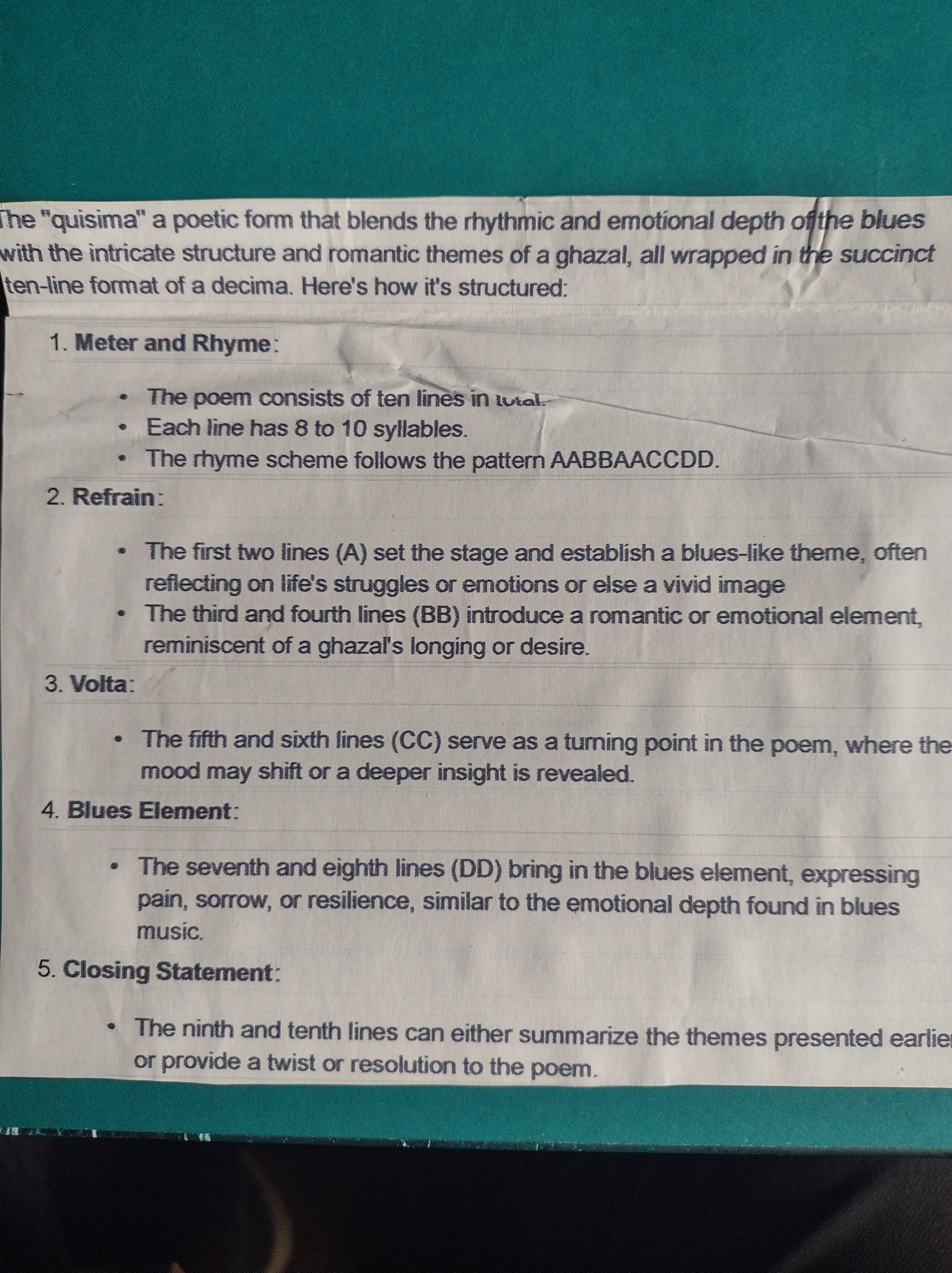
    Diving into Edward Hirsch’s “A Poet’s Glossary,” I searched for forms that could offer both structure and creative freedom. The ten-line decima caught my attention, with its generous allowance of 8-10 syllables per line. But other influences kept tugging at my sleeve: the blues music I’d loved for over five decades, with its raw emotional depth and distinctive rhythm; the elegant pivot of haiku; the passionate yearning in ghazals; the architectural precision of sonnets.

    The blues has been my constant companion for over five decades, and its influence runs deeper than just rhythm and rhyme. What draws me to blues music is how it transforms personal pain into shared experience – the way a singer can take a broken heart or an empty pocket and make it resonate with universal truth. Blues lyrics often follow a pattern of statement, development, and resolution, much like the best poems. They build tension through repetition, then release it with a surprising turn. I wanted my poetic form to capture this emotional architecture: the way blues singers can make a simple phrase carry the weight of generations, how they can squeeze hope from despair, or find humour in hardship. It’s not just about sadness – it’s about emotional honesty in all its forms.

    My journey to this form wasn’t straightforward. First attempts were too rigid, trying to force every element – blues, ghazal, haiku – into strict coordination. The poems felt mechanical, like they were assembled rather than written. Then I went too far the other way, making the structure so loose it provided no guidance at all. I filled pages with variations, testing different line lengths, playing with where to place the emotional turns. Some versions emphasized the blues elements but lost the lyrical qualities of the ghazal; others maintained formal precision but felt emotionally flat. Each failure taught me something about what I was really seeking: not a cage to contain the poems, but a trellis to help them grow.

    The structure I finally developed is meant to be flexible – more like jazz improvisation than classical music. While the basic elements remain constant (ten lines, the emotional arc, the blues influence), poets can adapt them to serve their vision. The syllable count of 8-10 per line is a suggestion rather than a rule – if a seven-syllable line carries the right weight, use it. The couplet structure can be maintained or abandoned as the poem demands. Even the positioning of the various elements can shift: the blues feeling might emerge earlier than lines seven and eight if that’s where the poem wants to go. What matters is maintaining the emotional trajectory: grounding the poem in concrete experience, allowing space for longing and reflection, and finding a way to transform these personal moments into something beautiful, that might appeal to either local or universal audiences.

    The Structure:

    Opening (Lines 1-2):

    These lines set the stage, either with a blues-inspired reflection on life’s struggles or a striking image that anchors the poem.

    The Heart (Lines 3-4):

    Here, I borrow from the ghazal tradition, introducing an element of longing or emotional revelation.

    The Turn (Lines 5-6):

    This is where the poem pivots, much like a haiku’s cutting word, offering a shift in perspective or a moment of insight.

    The Deep Blues (Lines 7-8):

    These lines channel the emotional authenticity of blues music, exploring themes of pain, resilience, or raw feeling.

    The Resolution (Lines 9-10):

    For the closing, I follow Stanley Kunitz’s wisdom: “Always end with an image and don’t explain” (Kunitz & Lentine, 2005, p. 84). These final lines can either gather the threads together or unravel them in an unexpected direction.

    Technical Framework:

    – Ten lines total

    – 8-10 syllables per line

    – Couplet structure (though this proved more flexible in practice)

    Further Reading:

    Ferris, W. (2009). Give My Poor Heart Ease: Voices of the Mississippi Blues. University of North Carolina Press.

    Hirsch, E. (2014). A Poet’s Glossary. Houghton Mifflin Harcourt.

    Khan, A. W. (2019). The Ghazal: A World Literature of Love, Loss and Longing. Bloomsbury Academic.

    Kunitz, S., & Lentine, G. (2005). The Wild Braid: A Poet Reflects on a Century in the Garden. W. W. Norton & Company.

    Reichhold, J. (2002). Writing and Enjoying Haiku: A Hands-on Guide. Kodansha International.

    Rispetto (8 lines, Italian origin)

    Nonet (9-line descending syllable poem)

    Shadorma (Spanish 6-line poem)

    Lai (9-line French form)

    Rondel

    13-14 lines

    French poetic form from 14th century

    Usually eight syllables per line

    Rhyme scheme: ABba abAB abbaA(B)

    Roundel

    11 lines

    English repeating form from 19th century

    Rhyme pattern: ABAa BAB ABAa

    Rondeau

    13-14 lines

    French repeating form

    Rhyme pattern: ABAaABab

    Magic 9

    9 lines

    Unique rhyme scheme: a b a c a d a b a

    Reportedly inspired by the word “abracadabra”

    Décima

    10 lines with 8 syllables per line

    Rhyme scheme: abbaaccddc

    Can be structured as a single stanza or two stanzas (abba/accddc)

    Often addresses social, philosophical, political, or religious themes

    Ghazal

    Composed of 5-15 couplets (shers)

    Each line must have the same number of syllables

    Includes a refrain (radif) at the end of every other line

    Traditionally focuses on themes of love, loss, and longing

    Canzone

    Italian form meaning “song”

    7-20 lines possible

    Each line typically 10-11 syllables long

    Triolet

    French form

    8 lines

    Constant repetitive rhymes

    First line repeated in lines 4 and 7

    Second line repeated in line 8

    A curtal sonnet is an 11-line poem invented by Gerard Manley Hopkins. Its key features are:

    Structure: 10.5 or 11 lines total

    Rhyme scheme: abcabc dcbdc or abcabc dbcdc

    Meter: Often uses sprung rhythm, with 4 stressed syllables per line

    Proportions: 3/4 the length of a Petrarchan sonnet

    First 8 lines of a sonnet become 6 lines (sestet)

    Last 6 lines become 4.5 lines (quatrain plus “tail”)

    Creative Discipline: 101 Days, 101 Poems at Sea

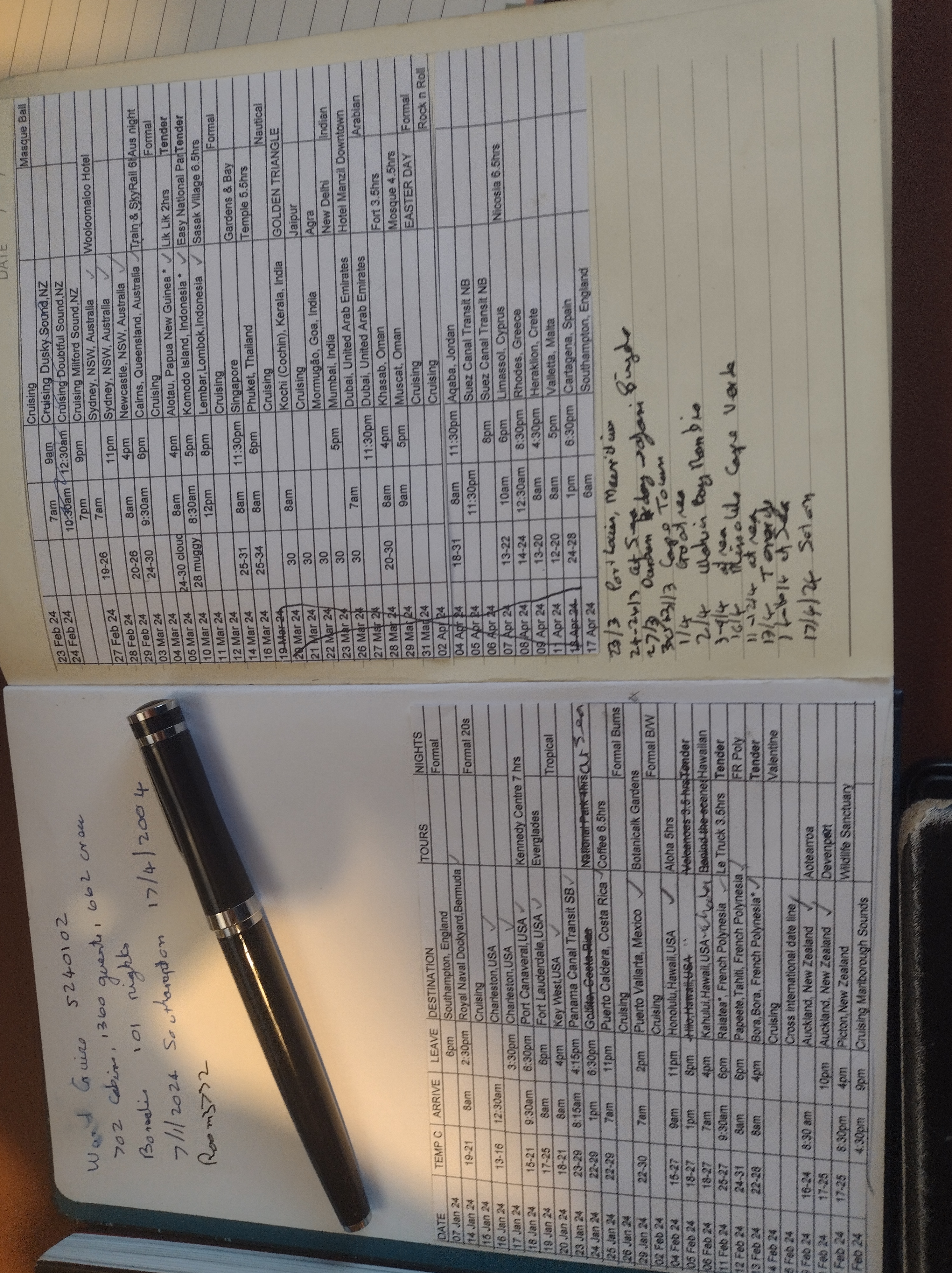
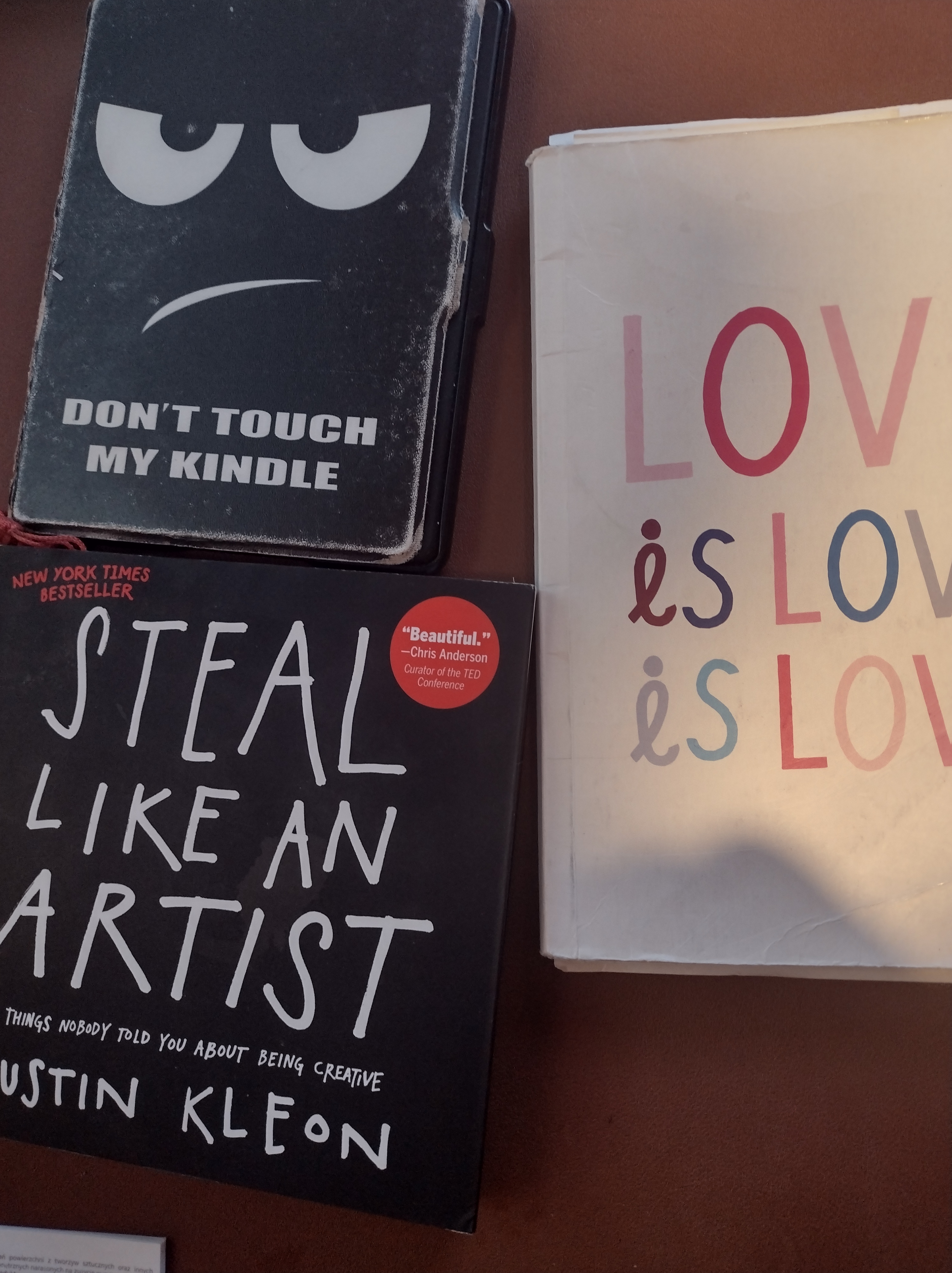
    Before I start there are a few pics. The first one shows the itinerary, and the changes to it and the pen I used to write the poems each day. While the second pics shows the cover of the Austin Kleon book, my Kindle loaded with poems and the notebook I used for the first rough draft.

    Establishing a Seafaring Routine

    Writing a poem daily encourages discipline and routine in my creative process, much like the structured rhythm of life aboard a cruise ship. It helps establish a daily writing habit, pushing the poet to engage with their craft regularly, whether inspired by the vast ocean or a bustling port city. There are 66 days at sea and 35 in port.

    Sailing Past Perfectionism

    With the goal of completing one poem each day, this practice emphasizes quantity over quality, helping me break free from the anchors of perfectionism, as if that’s been the case in the past. It encourages experimentation and spontaneity, allowing words to flow as freely as the waves beneath the ship[.

    Charting Improvement Through Practice

    Just as a seasoned sailor improves with each voyage, writing daily hones my technique, creativity, and fluency. Each port of call offers new inspirations and challenges, sharpening craft over time

    Exploring New Horizons

    Like discovering unexplored lands, writing a poem a day prompts me to delve into uncharted subjects, forms, and ideas. The constant need for new material expands creative boundaries, leading to surprising discoveries in the writing process.

    Embracing the Rough Seas

    Not every poem will be a masterpiece, just as not every day at sea is calm and sunny. The focus is on the journey rather than the destination, allowing for rough drafts and incomplete thoughts that can be refined and revised later.

    Developing a Poetic Compass

    Writing daily can help me discover or refine my unique voice, much like a ship finding its true north. Over time, patterns in theme, tone, and style emerge, guiding me towards my artistic true north.

    Mindfulness on the High Seas

    This practice becomes a form of daily reflection, where the poet uses writing to process the myriad experiences of life at sea. It can be a therapeutic activity, fostering introspection amidst the ever-changing seascape.

    I’ve already incorporated references to Austin Kleon’s “Steal Like an Artist” in the previous blog draft, drawing from multiple search results. Here are some additional insights and references to enrich the blog:

    Inspiration from Creative Voices

    Austin Kleon’s philosophy perfectly complements the 101-day poetry journey. As he notes, “Nothing is original” and artists should “steal like an artist” – meaning absorb influences, transform them, and create something uniquely personal. This approach aligns beautifully with my poetry project, where each day’s poem can be inspired by travel experiences, other poets, or creative influences.

    Poetic Healing and Wellbeing

    Recent research adds depth to my creative endeavour. A University of Plymouth study revealed that poetry can significantly impact mental health, helping people cope with loneliness, anxiety, and depression. Over 50% of participants in their research found that reading and writing poetry helped them process emotions and reduce isolation.

    Creative Lineage

    Audre Lorde’s said, “Poetry is not a luxury. It is a vital necessity of our existence.”

    Adrienne Rich states that poetry is “the skeleton architecture of our lives” and provides “a bridge across our fears of what has never been before”.

    Joy Harjo emphasizes poetry as a deep listening practice: “When I began to listen to poetry, it’s when I began to listen to the stones, and I began to listen to what the clouds had to say…”

    Alice Walker describes poetry as “the lifeblood of rebellion, revolution, and the raising of consciousness”

    Clarissa Pinkola Estes notes that poetry can be a lifeline, saying “There’s a reason poets often say, ‘Poetry saved my life’”

    Rita Dove describes poetry as “language at its most distilled and most powerful”

    W.H. Auden defines it as “the clear expression of mixed feelings”. These descriptions underscore poetry’s essential role in human communication and emotional processing.

    Consider Kleon’s advice:

    – Choose “friendly ghosts” (inspiring artists) to guide your creative process

    – Study works that resonate with you

    – Allow yourself to be influenced while developing your unique voice[2]

    Some references:

    Embracing the Daily Poetry Challenge: A Guide to Preparation and Benefits

    Setting the Stage for Success

    1. Prepare Tools

    – Dedicate a special notebook and pen for the poems

    – Keep a small notepad or use a phone app for capturing ideas on-the-go

    – Set up a comfortable writing space

    2. Embrace the Process, Not Perfection

    – Remember, the goal is consistency, not masterpieces

    – Write “rubbish” poems – they’re stepping stones to improvement

    – Experiment with different forms and techniques

    The Power of Daily Poetic Practice

    Writing a poem every day offers numerous benefits:

    1. Continuous Growth: Each poem is a chance to learn and improve craft

    2. Stress Reduction: The meditative nature of writing can lower stress levels

    3. Increased Creativity: Regular practice encourages innovative thinking

    4. Enhanced Self-awareness: Poetry helps explore my thoughts and feelings deeply

    5. Improved Problem-solving: Creativity boosts the ability to tackle challenges uniquely

    6. Building Resilience: Overcoming daily writing challenges strengthens perseverance

    Drawing Inspiration from Daily Life

    1. Sharpen Observation Skills

    – Practice mindful awareness of surroundings

    – Notice the small details in everyday scenes

    – Pay attention to all senses

    2. Mine Experiences

    – Personal interactions

    – Urban and natural environments

    3. Capture Ideas Quickly

    – Jot down interesting phrases or images

    – Take quick notes or voice memos

    – Sketch scenes or create mind maps

    Integrating Poetry into Routine

    1. Find Writing Time

    – Choose a consistent daily slot (e.g., morning, lunch break, before bed)

    – Start with just 5-10 minutes a day

    2. Low-Pressure Approach

    – Don’t aim for perfection – focus on showing up daily

    – Allow yourself to explore and experiment freely

    3. Stay Inspired

    – Read poetry regularly

    – Train the mind to think poetically throughout the day (whatever that means)

    – Share the journey with a creative community

    Some references: